
Growing Faster Than Your Finances? Here's How to Know

A growing business can create a strange financial problem: you can have more customers, more sales, and more work than ever—and still feel like you are constantly short on cash.
I have seen this happen with business owners who were doing many things right. Sales were climbing. The pipeline looked strong. The team was busy. On the surface, there was nothing to complain about.
But underneath that growth, payroll was increasing, customers were taking longer to pay, operating costs were climbing, and the business needed more cash just to support the next month of activity.
That is when growth stops being just a sales question and becomes a financial question.
The real issue is not whether your business is growing. It is whether your finances can support the pace of that growth.
Revenue can grow faster than your ability to fund it
One of the easiest mistakes to make is assuming that more revenue automatically means a stronger financial position.
It doesn't.
Suppose you win several large new customers. You may need to hire people, buy equipment, increase inventory, spend more on marketing, or carry additional operating costs before those customers' payments arrive.
Your income statement may show growth while your bank account tells a different story.
That doesn't necessarily mean the growth is bad. It means growth has a cost, and you need to understand when that cost will hit your cash flow.
A business that cannot fund its own growth may eventually have to slow down—not because demand disappeared, but because the financial foundation couldn't keep up.
Look at what each new dollar of revenue is costing you
The next question is profitability.
If revenue is increasing 25% but your costs are increasing 30%, you are not necessarily getting stronger. You may simply be getting bigger.
This is where I encourage business owners to look beyond total revenue and ask:
- Are gross margins holding up as sales increase?
- Are labor costs rising faster than revenue?
- Are certain customers or services less profitable than others?
- Are discounts or pricing decisions reducing the benefit of higher sales?
- Is overhead expanding faster than the business can support?
Growth should improve the economics of the business, not just its size.
If every additional dollar of revenue requires nearly as much additional spending, you may have a volume problem disguised as a growth story.
Your forecast should know about the problem before you do
Another warning sign is when financial decisions are being made based on the current bank balance.
The bank balance tells you where you are today. It does not tell you what happens after payroll, vendor payments, taxes, loan payments, and other commitments hit the account.
That is why forecasting matters so much during periods of growth.
A useful forecast should help you see what is likely to happen over the coming weeks and months. It should allow you to ask questions before making major commitments:
What happens if we hire two people?
What happens if a major customer pays 30 days late?
What happens if sales increase but margins fall?
Can we afford the expansion we're considering without putting pressure on the rest of the business?
You don't need a perfect prediction. You need enough visibility to make a better decision.
Growth can expose weaknesses you didn't have before
Financial strain isn't always caused by a lack of money. Sometimes it comes from systems that haven't caught up with the business.
The processes that worked when you had 10 employees and a handful of customers may not work when you have 30 employees and significantly more transactions.
Reporting gets delayed. Expenses become harder to monitor. Receivables receive less attention. Nobody is completely sure which numbers matter. The owner starts making decisions from incomplete information.
I've found that this is often when a business owner says, "We're doing more than ever, but I feel like I have less control."
That's an important signal.
Growth should create greater capacity—not greater confusion.
A client-inspired example: busy was not the same as healthy
I worked with a business owner whose company had experienced a significant increase in sales. He initially thought the next step was obvious: hire more people and keep pushing.
When we looked more closely, the picture changed.
Some of the additional revenue was tied to lower-margin work. Payroll was already rising. Receivables were stretching out. And the business was using more cash to deliver the increased volume before collecting the revenue.
The problem wasn't that the company had grown too much.
The problem was that the owner had been measuring growth primarily through sales.
Once we looked at cash requirements, margins, and the timing of collections together, the next decision became much clearer. Instead of simply adding more capacity, he could prioritize the work that produced better economics and plan hiring around actual cash requirements.
That is the kind of distinction good financial information should help you make.
Give your growth a financial stress test
You don't need a complicated model to start.
Each month, look at five things:
Revenue: Is sales growth continuing?
Margin: Are you keeping enough of each additional dollar?
Cash: Is operating cash keeping pace with the business?
Forecast: What financial pressure is likely over the next 60–90 days?
Capacity: Can your people, processes, and systems handle the next stage?
When those five answers are moving in the right direction, the foundation for growth is considerably stronger. When revenue is the only number improving, that's worth paying close attention to.
The goal isn't slower growth. It's growth that actually holds up.
Three decades of working alongside business owners, executives, and CFO teams has reinforced one thing consistently — growth doesn't fix what's broken inside a business. It amplifies it. Strong financial systems become more valuable as the company scales. Weak ones become more costly.
That's exactly why financial visibility has to grow alongside the business itself. At Straight Talk CPAs, we help owners connect real-time financial information with forward-looking guidance — so the question on the table isn't just where the business stands today, but what the next move actually means for cash flow, profitability, and where things are headed long-term.
Before the next big hire, expansion, or investment gets committed to, one question is worth sitting with:
Can my finances support the business I'm trying to build?
If the answer isn't clear, that's not a signal to stop. It's a signal to get sharper on the numbers before taking the next step forward.
Free eBook:
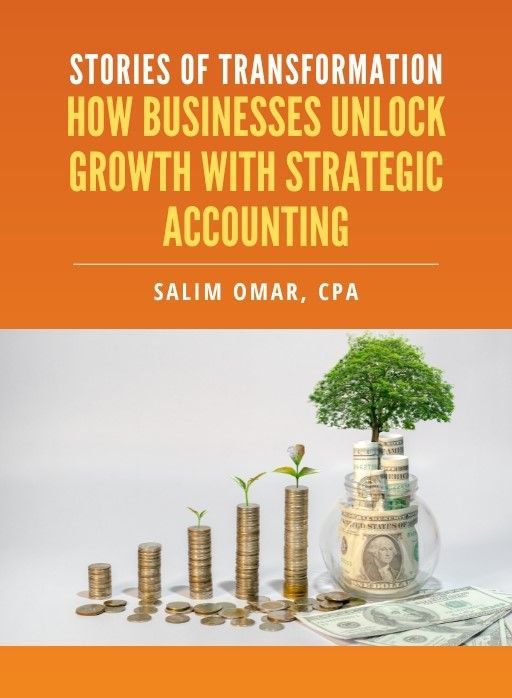
Stories of Transformation

Salim is a straight-talking CPA with 30+ years of entrepreneurial and accounting experience. His professional background includes experience as a former Chief Financial Officer and, for the last twenty-five years, as a serial 7-Figure entrepreneur.
Recent Posts