
Growing Revenue, Shrinking Cash? Here's Why

Strong sales month. Bank account tells a different story. It's a moment I've watched business owners sit with more times than I can count.
Revenue is climbing. The business looks busier than ever. The income statement might even be showing a healthy profit.
And yet cash feels tighter than it should.
That contradiction is disorienting but it's rarely actually a contradiction. Revenue, profit, and cash are measuring three different things. When a business starts moving fast, the distance between those three numbers can grow in ways nobody anticipated.
More Sales Can Create a Bigger Cash Problem
Growth costs money before it makes money.
Employees get paid before customers do. Inventory gets purchased. New projects get taken on. Marketing spend goes up. Equipment gets added. More resources flow into operations to keep pace with demand.
Meanwhile, customers are sitting on invoices for 30, 60, sometimes 90 days.
So the accounting records show a completed sale while the bank account is still waiting on the cash to arrive. This is exactly why I don't look at revenue growth by itself. The real question isn't whether more is being sold. It's whether that growth is actually converting into cash at a rate the business can work with.
Profit Doesn't Mean the Cash Is Available
This is the part that catches most owners off guard.
Say the business generates $200,000 in additional sales. After costs, the financials show a profit. That looks like progress.
But if $120,000 of those invoices are still sitting uncollected, the profit is already on the books while the cash hasn't moved. Payroll, rent, vendors, insurance, and every other operating obligation still come due on their own schedule.
A profitable business running short on cash isn't a sign of failure. It's a signal that cash conversion deserves serious attention.
A Client Situation I See Often
I worked with a growing business that had landed squarely in this position. Sales had jumped considerably. On paper, everything pointed upward.
The owner's question was simple: "We're doing more business than ever. Why does cash feel tighter?"
Looking past the headline numbers told the story. The company was carrying a growing receivables balance, absorbing additional operating costs to support the growth, and paying certain expenses well before customers were paying them. None of those issues looked serious on their own.
Together, they were quietly draining the business.
The answer wasn't to pull back on growth. It was to understand how that growth was actually being funded — because that changes everything about what the right response looks like.
Better collections. Different payment terms. Expenses phased more strategically. In some situations, additional financing to carry a growth cycle properly. None of those decisions are visible from a revenue number alone.
Watch What Happens Between the Sale and the Cash
When revenue grows while cash shrinks, a few specific relationships are worth examining closely.
Are customers taking longer to pay?
A swelling accounts receivable balance is one of the quieter ways cash disappears. If sales are rising but collections aren't keeping pace, growth may be creating a funding requirement the business wasn't prepared for.
Are costs outpacing what the business can support?
Hiring ahead of demand, expanding facilities, stocking more inventory, adding technology — these can all be sound moves. The issue is always timing. The business needs enough cash on hand to carry those investments until they start producing a return.
Are margins actually improving?
Additional revenue doesn't automatically mean additional value. Generating more sales at thin margins increases workload and cash requirements without creating enough profit to justify the effort.
What does the next 90 days actually look like?
This is the question owners tend to ask too late. Looking backward explains what happened. A cash flow forecast shows whether today's decisions are quietly building toward a shortage next month or next quarter.
Growth Needs a Cash Plan, Not Just a Sales Target
Setting a revenue goal without understanding the cash required to reach it is one of the more common mistakes I see and one of the more expensive ones.
If the plan is to grow by 20%, the real question is what that growth actually demands.
More employees? More inventory? More equipment? Higher marketing spend? Longer customer payment windows? Additional working capital sitting in reserve?
Revenue is one side of the equation. The cash needed to support it is the other. Treating them as the same thing is where businesses get into trouble.
This is where financial forecasting stops being a spreadsheet exercise and becomes an actual management tool. A solid forecast lets you pressure-test decisions before real money gets committed — whether the business has room to hire, expand, take on a major customer, or whether the timing needs to shift first.
Don't Wait for the Bank Balance to Warn You
A dropping cash balance is usually the last symptom, not the first warning.
By the time an owner recognizes there isn't enough cash, the underlying conditions — slower collections, compressed margins, rising expenses, growth that moved faster than the finances could support — have often been developing for months.
Looking at revenue, margins, receivables, expenses, and projected cash as a connected picture rather than separate reports is what allows problems to surface early enough actually to do something about them.
The goal isn't to become an accountant. It's to understand what the financial information is saying about the business being run.
The Practical Takeaway
If revenue is growing while cash is shrinking, more sales probably aren't the answer — at least not yet.
Start with three questions:
Where is cash getting tied up?
Is the new revenue generating enough margin to justify itself?
What will the cash position look like 60 to 90 days from now?
Those answers reveal far more about the quality of growth than any revenue figure ever will.
At
Straight Talk CPAs, we help business owners look past historical financial statements and understand what their numbers actually mean for the decisions sitting in front of them. With better
financial visibility, forward-looking forecasting, and ongoing guidance, owners can catch pressure earlier, plan with real confidence, and grow without letting the growth itself become the thing that breaks them.
Free eBook:
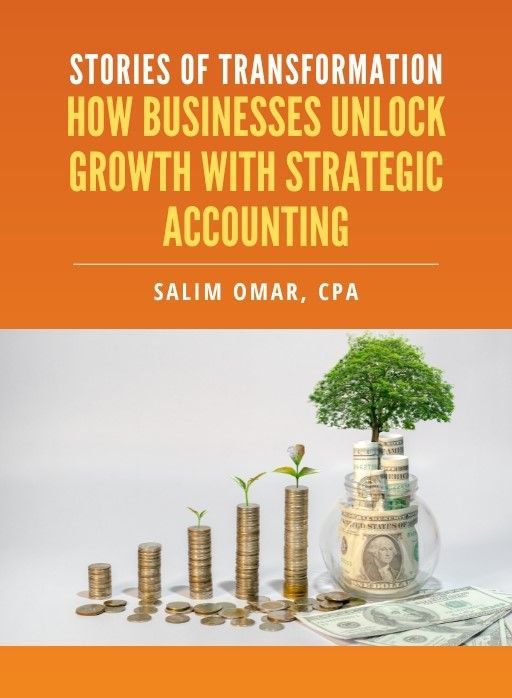
Stories of Transformation

Salim is a straight-talking CPA with 30+ years of entrepreneurial and accounting experience. His professional background includes experience as a former Chief Financial Officer and, for the last twenty-five years, as a serial 7-Figure entrepreneur.
Recent Posts