
The Hidden Cost of Hiring Too Fast

When the team is underwater, bringing someone new on board feels like the logical next step.
Customers are waiting. Existing employees are running on empty. The owner is handling work that should have been handed off months ago. Revenue might even be climbing.
The pressure builds until it comes to a conclusion: We need someone now.
That pressure has pushed more than a few careful business owners into hiring decisions they later wished they'd taken more time with.
The hire itself usually isn't the problem.
The problem is that urgency became the decision-making process.
I'm Salim Omar. After three decades of running businesses, working as a senior executive and CFO, and advising business owners through some genuinely difficult calls, I've come to see hiring decisions differently. They're rarely just people's decisions.
Every hire is a financial commitment, one that can quietly reshape margins, cash flow, management capacity, and growth plans for months or years down the road.
And when it happens too fast, some of those consequences don't show up until well after the damage is done.
The Expensive Part May Start After the Offer Is Accepted
Most owners can work through the obvious costs going in: salary, benefits, recruiting fees, equipment, initial training. That math isn't hard.
The harder costs are the ones that never appear on the P&L.
A rushed hire often needs more supervision than anyone planned for. Someone on the existing team ends up spending hours cleaning up their work. Customers start noticing delays. Projects that should have moved faster don't. The owner, who hired specifically to get out of the weeds, finds themselves managing a problem that's bigger than the one they started with.
And if the person doesn't work out, the business isn't simply back where it started.
There's been a full recruiting cycle, a training investment, a productivity gap, and now the whole process starts over from scratch.
The cost of a bad hire runs well past salary and recruitment — it shows up in management time, team performance, and the momentum that quietly gets lost along the way.
The Trap Is Usually a Legitimate Business Problem
What makes rushed hiring so difficult to catch is that the underlying problem is almost always real.
Sales picked up and the team can't keep pace. The owner is buried in operations. A key person left without warning. A new opportunity showed up that requires more capacity than currently exists.
The mistake isn't recognizing the problem. It's assuming that because the problem is urgent, the solution has to be immediate.
Sometimes it does. But sometimes the business needs something else first.
- Could the workload be restructured?
- Could a process be automated?
- Could lower-value work move internally?
- Could a contractor absorb a temporary spike?
- Could pricing shift to make the additional capacity actually worth running?
Those questions don't eliminate the hire. They help determine whether the hire is actually solving the right problem or just the most visible one.
A Client Once Showed Me Why Timing Matters
I worked with a business owner whose team had hit a wall after a stretch of strong growth. Another full-time employee felt like the obvious move.
The surface-level case was reasonable enough.
But when we got into the financial picture, something stood out. The additional revenue wasn't producing the margin the owner had assumed, and several customers were consistently slow to pay.
The business could technically cover another salary. It couldn't comfortably absorb another fixed expense if sales softened for even a couple of months.
So instead of asking "can we hire this person," we shifted to what needed to happen first.
Collections got tightened. Several customer accounts got looked at for actual profitability. The role itself got defined more clearly in terms of what capacity it actually needed to generate.
The hiring decision that followed was a much sounder one.
That distinction matters:
financial analysis doesn't always tell you not to hire. Sometimes it tells you exactly when the hire becomes the right move.
Watch What Happens to Your Margin
One of the most common ways to underestimate a new hire is to anchor the conversation on revenue instead of contribution.
Say a new salesperson is expected to bring in $300,000 in additional annual revenue. That sounds compelling on its own.
But if the work tied to that revenue carries a 25% gross margin, you're looking at $75,000 in gross profit — before accounting for the cost of the employee and everything else required to support that volume.
The same dynamic plays out in operations. A new hire might create the capacity to serve more customers, but if doing so requires meaningful overtime, materials, software, vehicles, or management bandwidth, the economics can look very different from what the original case suggested.
Capacity only creates value when the economics behind it actually work.
There's Another Cost Owners Rarely Put on Paper
Owner time.
In a small or midsize business, a poor hiring decision has a way of pulling the owner away from the work that actually moves the company.
Instead of selling, developing key relationships, managing cash, or sharpening strategy, the owner is reviewing errors, working through employee issues, and trying to figure out why the new hire isn't producing. That opportunity cost doesn't show up anywhere in the financials but it's real, and it compounds.
This is why I don't look at hiring decisions in isolation. The role needs to make sense not just on a spreadsheet but in terms of how it changes the owner's workload, the team's output, and the company's overall financial trajectory.
Slow Down Enough to Make the Decision Faster
Before moving toward an offer, put the role through a straightforward financial pressure test.
Ask:
What problem will this person actually solve?
What additional revenue, capacity, or efficiency should the role produce?
How long before the employee reaches full productivity?
What does cash flow look like during that ramp-up window?
What happens if revenue comes in 20% below expectations?
What if the hire takes twice as long to get up to speed?
None of this requires a sophisticated financial model. It does require looking forward rather than making the decision from last month's income statement or whatever is sitting in the bank account today.
That's exactly where financial visibility earns its place.
Don't Let Today's Pressure Make a Five-Year Decision
A hiring decision can solve this quarter's bottleneck and create next year's financial headache.
It can also work the other direction — waiting too long costs customers, burns out good people, and leaves profitable opportunities sitting on the table unclaimed.
The goal isn't to hire slowly.
It's to hire deliberately.
Before the next offer goes out, identify what business problem is actually being solved. Quantify what fixing it should be worth. Understand what the cash flow implications look like. Then stress-test what happens when the assumptions turn out to be optimistic.
At Straight Talk CPAs, we help business owners work through exactly those decisions — using current financial data and forward-looking analysis, not just a summary of what already happened on the books.
Because the best hiring decision isn't always the fastest one.
It's the one made with a clear understanding of what's being committed to, what's expected in return, and what the business can actually handle if things don't go according to plan.
Free eBook:
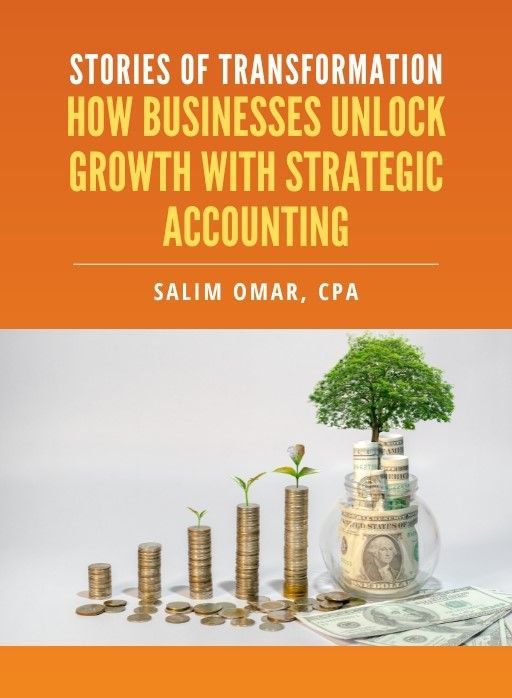
Stories of Transformation

Salim is a straight-talking CPA with 30+ years of entrepreneurial and accounting experience. His professional background includes experience as a former Chief Financial Officer and, for the last twenty-five years, as a serial 7-Figure entrepreneur.
Recent Posts