
What Smart Business Owners Do Right After Filing Taxes

Filing your taxes often feels like a finish line.
The deadlines are behind you. The numbers are finalized. There’s a sense of relief that comes from knowing it’s done.
And for many business owners, that’s where the process ends.
From our perspective, that’s where the real opportunity begins.
As I often explain to clients, filing a return doesn’t improve your business by itself. It doesn’t increase profitability, fix inefficiencies, or create better outcomes. What it does is something far more important: it gives you a clear, documented picture of what your decisions produced over the past year.
The issue is that most people stop at that point. They file, move on, and never extract the insight that’s sitting right in front of them.
What Most Business Owners Do and Why It Costs Them
Once the return is filed, the instinct is to move forward.
The document gets saved, organized, and put away. Attention shifts back to operations serving clients, generating revenue, and managing day-to-day responsibilities.
Nothing feels urgent. Nothing appears broken.
But that’s exactly where the gap begins.
Because your tax return is one of the most complete summaries of how your business actually performed over an entire year. It captures not just your income and expenses, but the financial impact of the decisions you made, how you priced your services, how you managed costs, how and when you reinvested, and how cash ultimately flowed through the business.
When that information is ignored, the same patterns tend to carry forward. Assumptions go unchallenged. Inefficiencies remain in place. And the next year is often shaped by the same decisions that created the last one.
That’s the real cost, not the tax itself, but the missed opportunity to improve what comes next.
What Smart Business Owners Do Differently
The business owners who get the most value out of their numbers approach this differently.
They don’t treat the return as something to archive.
They treat it as something to interpret.
Instead of asking, “Is this done?” they step back and ask a more useful question:
👉 What is this telling me about how my business is actually operating?
That shift in perspective is where better decisions begin.
Because now the return becomes more than a compliance document. It becomes a reference point for understanding performance.
When you review it properly, it starts to reveal patterns that aren’t always obvious during the year:
- Where your profitability is truly coming from
- Which expenses are contributing to growth, and which are simply adding cost
- How timing decisions affected your cash position
- Whether increased activity actually translates into better results
These are not new numbers.
But they offer a much clearer understanding of what those numbers mean and how they should influence your next set of decisions.
A Real Situation: Growth Without Clarity
We recently worked with a business owner who had just completed their filing after what appeared to be a very strong year.
Revenue had increased. The business was expanding. From an outside perspective, everything seemed to be moving in the right direction.
And yet, there was hesitation.
They told us, “We had our best year, but I don’t feel like I understand how we got here or what I should be doing differently going forward.”
The return itself was accurate. There were no errors to correct.
But accuracy and clarity are not the same thing.
When we reviewed the return together from a strategic standpoint, the underlying issue became clear.
Revenue had grown, but not evenly across services. Some areas were performing significantly better than others.
Expenses had also increased, but not always in proportion to what was actually driving that growth. And several decisions, particularly around reinvestment and distributions, had been made independently, rather than as part of a coordinated plan.
The return reflected all of this.
It simply hadn’t been analyzed in that way.
So instead of filing it away, we used it as a starting point. We broke down how different parts of the business contributed to overall results, identified where resources were being used effectively and where they weren’t, and aligned those insights with the decisions that needed to be made next.
By the end of that conversation, their response was simple:
“This is the first time I’ve looked at my taxes and actually understood what to do with them.”
That’s the difference between filing a return and using it.
Why This Step Matters More Than It Seems
Once your return is filed, the numbers themselves are final.
But the impact of those numbers on your future decisions is not.
If the return is ignored, the same patterns tend to repeat. The same gaps remain in place. And the same surprises show up again, often with larger consequences.
If the return is used intentionally, something different happens. Decisions become more informed. Cash flow becomes easier to manage. Growth becomes something you can evaluate and guide, not just react to.
As I often tell clients:
“You can’t change what already happened. But you can decide whether you learn from it or repeat it.”
That decision is what separates reactive businesses from strategic ones.
What to Do Right After Filing
The objective at this stage is not to take more action for the sake of being busy.
It’s to make better decisions based on what you now know.
That starts with a focused review of your return:
- Understand where your profit actually came from, not just your revenue
- Identify which expenses contributed to the results and which did not
- Look for patterns that should be continued, adjusted, or stopped
- Connect those insights to the decisions you’re currently making in the business
Because the reality is, your next tax outcome is not created at the end of the year.
It’s being shaped right now through the choices you make every day.
Don’t Let This Window Close
There is a short window after filing where your numbers are still fresh, and the full picture is clear.
That’s when this exercise is most valuable.
If too much time passes, the urgency fades. Day-to-day demands take over. And the opportunity to act on those insights is often lost.
At that point, the return becomes what most people treat as a record for compliance, rather than a tool for improvement.
Used correctly, it can be much more than that.
It can provide direction.
Turn Your Tax Return Into a Strategy, Not a Record
This is one of the most overlooked steps in running a business effectively.
And it’s also one of the most impactful.
If you actually sit down and understand what your return is showing you, your next decisions become a lot more intentional and a lot less guesswork.
If you don’t, it’s easy to fall into the same patterns again without even noticing.
And if you’d rather not figure it all out on your own, we can walk you through it.
Free eBook:
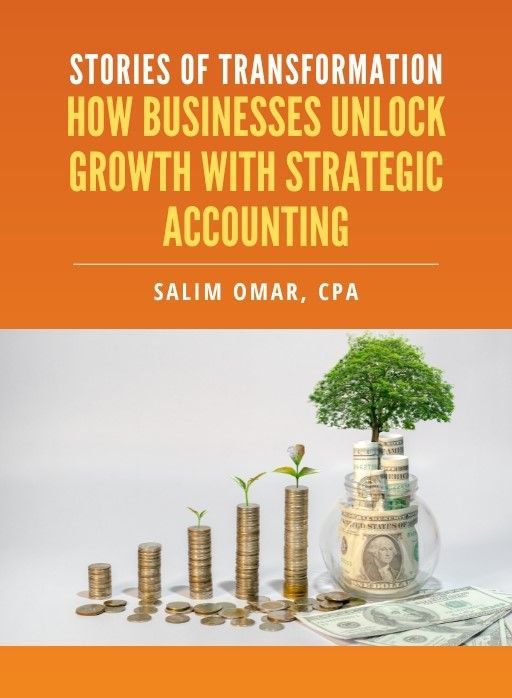
Stories of Transformation

Salim is a straight-talking CPA with 30+ years of entrepreneurial and accounting experience. His professional background includes experience as a former Chief Financial Officer and, for the last twenty-five years, as a serial 7-Figure entrepreneur.
Recent Posts