
Why Side Hustlers Get Surprised by Tax Bills and How to Prevent It

Most side hustlers don’t expect their first real tax bill.
The money comes in, the work feels straightforward, and nothing along the way suggests there’s a problem building in the background.
Then tax season arrives, and suddenly, a portion of that income was never really yours to keep.
As Salim Omar, CPA and founder of Straight Talk CPAs, often explains,
“Side income feels simple while you’re earning it. But from a tax perspective, it’s being treated very differently from the start.”
Why the Surprise Happens (Even When Nothing Was Done Wrong)
Most side hustlers don’t make obvious mistakes.
They track income. They keep basic records. They assume taxes will work similarly to how they do with a regular paycheck.
That assumption is where the disconnect begins.
Unlike salaried income, side income typically has:
- No taxes withheld
- Different classification rules
- Additional layers, like the self-employment tax
So while the income feels like a bonus, it’s actually creating a separate set of obligations that aren’t visible in real time.
And because nothing feels urgent during the year, those obligations build quietly in the background.
When Growth Outpaces Awareness
What makes this more challenging is how quickly side income can scale.
A few projects turn into consistent revenue. What started as occasional work becomes something more structured, but the financial approach doesn’t always evolve with it.
Decisions continue to be made casually:
- Income is received without planning for tax impact
- Expenses are tracked loosely or not fully categorized
- No adjustments are made to account for changing income levels
Individually, these don’t feel significant.
But over time, they shape the outcome.
As Omar notes,
“The tax bill doesn’t come from one big mistake. It comes from a series of small decisions that were never connected.”
A Situation That Feels Familiar
We worked with a professional who had started freelancing alongside a full-time job. What began as occasional work quickly turned into a steady income stream over the course of a year.
From their perspective, everything was going well.
“It felt like extra money,” they told us. “I wasn’t treating it like a business, I was just taking on more work.”
When tax season arrived, the result was unexpected.
Not because anything had been done incorrectly, but because nothing had been planned.
No taxes had been set aside. Income had increased without adjusting expectations. And the way that income was structured created a larger obligation than anticipated.
The reaction wasn’t confusion.
It was a surprise.
“I didn’t realize how much of this wasn’t actually mine to keep.”
The Shift: From Surprise to Control
What changed for this client wasn’t the income.
It was how decisions were made around it.
Instead of reacting at the end of the year, we helped them start thinking about their side income as something that needed structure from the moment it was earned.
That meant:
- setting aside a consistent portion for taxes
- evaluating how income was being received and reported
- aligning expenses and deductions with how the work was actually performed
- introducing a simple system to track and plan throughout the year
Nothing overly complex.
But intentional.
And that’s what changed the outcome.
How to Prevent It (Before It Happens Again)
Avoiding this situation isn’t about knowing more tax rules.
It’s about shifting how you approach your side income from the beginning.
That starts with understanding that:
The moment you earn side income, you’ve created a separate financial layer that needs its own structure.
From there, a few key changes make a significant difference:
- Treating income as partially reserved, not fully available
- Making decisions with tax impact in mind, not just cash flow
- Reviewing income and expenses consistently, not just at year-end
- Thinking ahead, rather than catching up
As Omar explains,
“The goal isn’t to fix the tax bill later. It’s to make sure it doesn’t come as a surprise in the first place.”
Before Your Side Hustle Grows Further, Put Structure Around It
Side income has a way of becoming something bigger.
And when it does, the way it’s handled early on starts to matter more.
If your income is growing but your tax outcomes feel unpredictable, the issue isn’t the work you’re doing; it’s how that work is being structured behind the scenes.
We help you bring clarity to that early, so your growth doesn’t come with unexpected setbacks.
Free eBook:
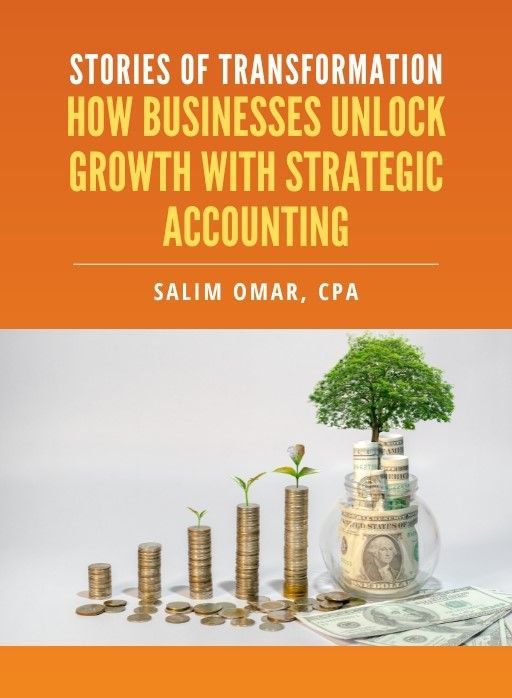
Stories of Transformation

Salim is a straight-talking CPA with 30+ years of entrepreneurial and accounting experience. His professional background includes experience as a former Chief Financial Officer and, for the last twenty-five years, as a serial 7-Figure entrepreneur.
Recent Posts