
How to Tell if Your Business Is Actually Having a Good Year

I've met business owners who hit record revenue and ended the year frustrated.
I've also met owners who spent months convinced things were going sideways, only to find out the business was in the best shape it had ever been.
That's because a genuinely good year is harder to identify than most people think.
I'm Salim Omar, founder of Straight Talk CPAs, and after decades working with entrepreneurial businesses, I've come to believe that revenue is one of the least reliable ways to judge how a company is actually doing. Most owners look at sales first. If the number is up, the year feels like a win. If it's flat, the year feels like a disappointment.
But a business can grow and quietly become weaker. It can grow slowly and become dramatically stronger. The difference almost never shows up in the top line.
Revenue Doesn't Tell You How Much You're Keeping
When I look at a business, the first thing I want to know isn't how much it sold. It's how much it kept.
I've seen companies add hundreds of thousands in revenue and end up with very little to show for it. More sales brought more complexity, more labor, more overhead, more strain. On paper it looked like growth. Inside the business, not much had actually improved.
A genuinely good year shows up in profitability, not just sales volume. The real question isn't whether revenue grew. It's whether the business became more financially productive.
A Good Year Usually Creates Better Cash Flow
Healthy businesses tend to gain flexibility over time, and one of the clearest signs of that is what happens to cash flow.
Not necessarily bigger bank balances. More control.
Can the business handle payroll, taxes, inventory, and an unexpected expense without scrambling?
Can an opportunity be acted on without creating financial stress?
Can leadership make decisions without one eye constantly on the bank account?
When cash flow genuinely improves, owners tend to experience something they haven't felt in a while. In my experience, that feeling is a far stronger indicator of a good year than a revenue number ever will be.
Strong Businesses Make the Future Easier to See
One of the most underrated signs that a business is heading in the right direction is better financial visibility.
Forecasts start becoming more reliable. Cash flow gets more predictable. Decisions that used to feel reactive start feeling more intentional. Instead of constantly responding to whatever just happened, owners start making calls with real confidence about what the next six to twelve months are likely to look like.
That kind of visibility is one of the biggest advantages a business can build. It cuts down on uncertainty, improves decision making, and lets leadership actually focus on opportunities instead of putting out fires.
Strong Businesses Create More Choices
One of the most overlooked signs of real progress is what happens to your options.
At the start of the year, maybe you wanted to bring on a key hire, invest in equipment, launch something new, or push into a different market. The question worth asking mid-year is whether the business can actually support those moves now.
Good years tend to open doors. Difficult years tend to close them.
When I'm reviewing a business, one of the questions I come back to is simple: do you have more options today than you did six months ago? The answer tells you a lot. Financial strength doesn't just show up in reports. It shows up in the quality of decisions available to you.
Progress Often Looks Different Than Expected
Not long ago I worked with a business owner who was worried because revenue growth had slowed compared to prior years. The assumption was that something was wrong.
But when we actually got into the numbers, a very different picture came out.
The company had raised its prices, gotten operationally leaner, cut expenses that weren't pulling their weight, and become more selective about the work it took on. Revenue growth had moderated. But profitability had improved, cash flow was stronger, and the owner had a much clearer view of where things were heading.
On paper, it looked like a step back. In reality, the business had never been in better shape.
That gap is worth thinking about. The businesses that look the most impressive from the outside aren't always the ones building something that lasts. Real strength doesn't always show up in the top line, sometimes it's happening quietly underneath it.
Look at What the Numbers Are Really Telling You
A genuinely good year leaves real clues. Profitability improves. Cash flow gets more predictable. Financial visibility gets better. Decisions get easier. Future opportunities feel more within reach. Risk becomes something you can actually see and plan around.
Those are the things I pay attention to far more than revenue.
Before you call the year a success or a disappointment, take a step back and ask a few honest questions.
- Is the business keeping more of what it earns?
- Is cash flow becoming more predictable?
- Are there more options for growth than there were six months ago?
- Are big decisions getting easier or harder?
- Is the business genuinely stronger than it was at the start of the year?
Those questions will tell you far more than any sales report.
At Straight Talk CPAs, these are the conversations we find most valuable helping business owners look past the surface numbers, understand what their financials are actually saying, and make decisions based on the long-term health of the business rather than how the top line looks on any given month.
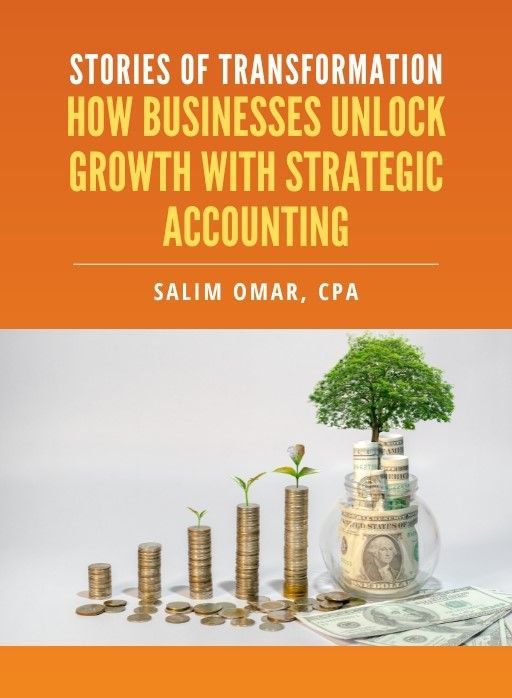
Free eBook:
Stories of Transformation

Salim is a straight-talking CPA with 30+ years of entrepreneurial and accounting experience. His professional background includes experience as a former Chief Financial Officer and, for the last twenty-five years, as a serial 7-Figure entrepreneur.
Recent Posts