
Inventory, COGS, and Write-Offs: What Online Sellers Get Wrong

In our experience with e-commerce businesses, we’ve noticed a consistent pattern: inventory, cost of goods sold (COGS), and write-offs are often treated as routine accounting functions. They’re tracked, reported, and reviewed.
On the surface, everything appears in order.
But the issue isn’t whether these numbers exist; it’s whether they reflect how the business is actually operating.
As Salim Omar, CPA and founder of Straight Talk CPAs, often points out,
“Most e-commerce businesses don’t have an inventory problem; they have a visibility problem. They’re making decisions based on numbers that feel complete, but aren’t.”
Many sellers assume that once inventory is recorded and COGS is calculated, they have a clear understanding of profitability. In reality, those numbers are often built on incomplete assumptions. Inventory may be valued based on outdated inputs. COGS may exclude cost elements that materially affect margins. Write-offs may be recorded, but not examined.
Individually, these gaps seem minor. Collectively, they begin to distort decision-making.
When Inventory Becomes a Blind Spot
Inventory is often treated as a static asset. In practice, it behaves more like a moving financial decision.
We regularly see businesses reordering products based on sales velocity, without fully understanding how long capital is tied up in stock. Slow-moving inventory continues to sit on the books at full value, even when it’s unlikely to convert at expected margins.
Over time, this creates a disconnect between reported performance and actual financial position.
As Omar explains,
“Inventory isn’t just something you track, it’s a reflection of how capital is being deployed. And in many cases, it’s being deployed without enough scrutiny.”
The numbers don’t always make that visible.
The COGS Miscalculation
COGS is rarely as complete as it appears.
Many e-commerce businesses calculate it narrowly, focusing only on product cost while excluding shipping variability, packaging, platform fees, and returns. These costs don’t disappear; they simply sit outside margin calculations.
As a result, margins appear stronger than they are.
Decisions related to pricing, promotions, and scaling are then made on numbers that don’t fully capture the cost structure of the business.
Omar notes,
“When key costs sit outside COGS, margins look healthier than they actually are. And that changes how aggressively businesses choose to scale.”
Write-Offs Are Signals, Not Cleanup
Write-offs are often treated as something to handle at the end of a reporting cycle.
From our perspective, they’re one of the clearest signals available.
Consistent write-offs are rarely random. They tend to point to deeper issues, such as over-ordering, weak demand forecasting, or misalignment in product decisions. When they’re treated as isolated adjustments, the underlying pattern is missed.
And the same mistakes tend to repeat.
A Real Example: Where the Numbers Looked Right
We worked with an e-commerce brand in the home goods category that had crossed seven figures in annual revenue. On paper, the business looked strong, with steady growth, positive margins, and clean reports.
But the founder described a different reality:
“We were growing, but it never felt like we were getting ahead.”
Cash flow was tightening. Inventory levels were increasing. Decisions around reordering and promotions were becoming harder to evaluate with confidence.
When we reviewed the financials, nothing appeared fundamentally broken. Inventory was being tracked. COGS was being calculated. Write-offs were recorded.
The issue was how those numbers were constructed.
A portion of their inventory consisted of slow-moving SKUs that were still valued at full cost. Several indirect costs, particularly related to fulfillment and returns, were not consistently included in COGS. Write-offs had occurred, but there was no structured analysis behind them.
Instead of overhauling everything, we focused on rebuilding clarity.
We restructured inventory valuation to reflect realistic sell-through. We expanded COGS to include all relevant cost components. We introduced a consistent review process to connect write-offs back to purchasing decisions.
Within a few months, the shift was noticeable.
Margins adjusted into a more accurate range. Inventory purchasing became more disciplined. Most importantly, decisions that previously felt uncertain became clearer because they were based on numbers that reflected reality.
As Omar puts it,
“This is more common than most realize. The numbers aren’t necessarily wrong, but they’re not structured to support the decisions the business is trying to make.”
The Real Risk: False Confidence
What concerns us most isn’t that the numbers are completely wrong.
It’s that they often look right.
When inventory appears healthy, margins seem stable, and write-offs are quietly absorbed, decisions feel justified. But if those numbers don’t fully reflect how the business operates, that confidence can lead to decisions that quietly put pressure on cash flow and profitability.
Businesses don’t usually notice this immediately.
They feel it over time.
A Different Way to Look at It
In e-commerce, growth can happen quickly. But financial clarity doesn’t always keep pace.
From what we’ve seen, the issue isn’t complexity; it’s interpretation.
Inventory, COGS, and write-offs are not just accounting elements. They are decision inputs. And the quality of those inputs directly shapes how effectively a business can scale.
As a final point, Salim Omar adds,
“The goal isn’t just accurate reporting. It’s having numbers you can rely on before making decisions, not after.”
The businesses that do well over time aren’t always the ones with the fanciest systems. They’re the ones that keep their numbers real and accurate and actually use them to make smarter decisions.
Get Clarity Before You Decide
If your inventory, COGS, or write-offs don’t fully reflect how your business operates, your decisions won’t either.
We’ll help you see what your numbers are actually telling you.
Free eBook:
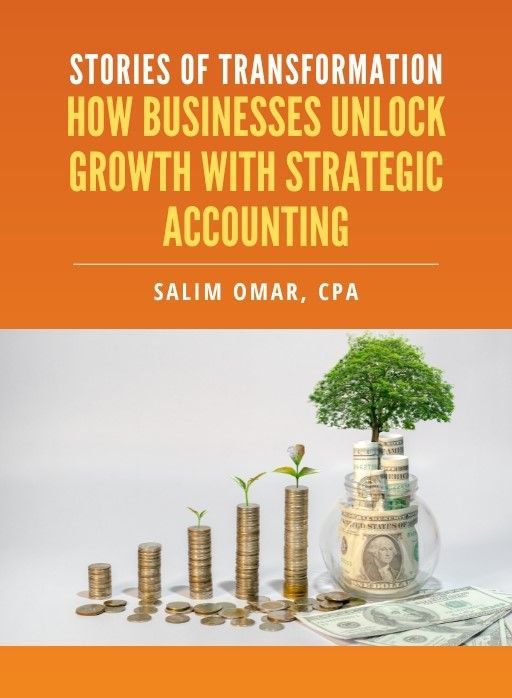
Stories of Transformation

Salim is a straight-talking CPA with 30+ years of entrepreneurial and accounting experience. His professional background includes experience as a former Chief Financial Officer and, for the last twenty-five years, as a serial 7-Figure entrepreneur.
Recent Posts