
When to Hire an Outsourced CFO

When to Hire an Outsourced CFO: 12 Signs Your Business May Be Ready
Nobody sits down one day and decides they need an outsourced CFO. It's not that kind of decision.
Instead, it starts with questions they never had to ask before.
- Why does cash still feel tight even though revenue is growing?
- Can we afford to hire more people? Is now the right time to expand?
- Why do our financial reports tell us what happened last month but offer little insight into what comes next?
These questions rarely appear all at once. They tend to emerge as the business grows. What once felt straightforward becomes more complex. Decisions carry greater consequences, growth introduces new challenges, and there's less room for costly mistakes.
What's important to understand is that this is rarely a data problem. Most businesses already have reports, spreadsheets, and financial statements. The challenge is knowing what those numbers mean and how they should influence future decisions.
That's often the point where outsourced CFO services enter the conversation.
But whether your business is truly ready for that level of support is a different question. Bring in CFO-level guidance too early, and you may be paying for expertise you don't yet need. Wait too long, and you risk making important decisions without the financial insight to support them.
Understanding where your business stands starts with recognizing the signs.
When Accounting Stops Being Enough
Good accounting is essential. It keeps your records accurate, supports compliance, and tells you what happened financially. But at some point, looking backward isn't enough to move forward.
As businesses grow, owners start facing questions that accounting wasn't built to answer:
- Can we afford another salesperson?
- Should we open a second location?
- Are we priced right?
- Which services actually make us money?
- What happens if revenue dips next quarter?
These aren't accounting questions. They're business decisions, and they need a different kind of financial thinking.
Over nearly three decades working with growing businesses, Salim Omar, Founder and CEO of Straight Talk CPAs, has seen the same pattern repeatedly. Businesses rarely struggle because they lack financial data. They struggle because they don't have a clear way to turn that data into decisions.
12 Signs You Might Be Ready for an Outsourced CFO
1. Revenue is growing, but cash still feels tight
Sales are up, demand is strong, yet cash always seems to be running thin. A contractor might land several big projects at once, but payroll and materials must be paid weeks before the client pays. Growth creates pressure that must be relieved.
2. Big decisions are being made on instinct
Hiring, expanding, buying equipment, launching a new service, every one of these carries financial consequences. If those calls are being made without real analysis behind them, the business is operating without a full picture.
3. You know your revenue but not what's driving profit
Most owners know last quarter's revenue. Far fewer know which clients are actually profitable, which services carry the best margins, or where money is quietly being lost. We've seen businesses grow revenue steadily while profitability slipped because nobody was tracking what was driving it.
4. Reports arrive every month, but don't change anything
Receiving financial statements isn't the same as using them. If your reports don't influence decisions, there's a gap between your numbers and your leadership.
5. You can't clearly see what's coming
Can you explain what the next six months might look like? Many owners know where things stand today, but struggle to anticipate what's ahead. Decisions become reactive instead of planned.
6. Growth feels stressful instead of exciting
More employees, bigger expenses, additional systems, and rising customer demand can add complexity faster than most owners expect. When it consistently creates stress instead of confidence, that's a sign you need stronger financial leadership.
7. You're preparing for financing or expansion
Banks and investors want more than historical statements. They want to see how you plan to grow, how you're managing risk, and whether there's a real financial strategy behind it. Most businesses discover they need a better financial footing before they need the capital.
8. Every financial question land on your desk
When every pricing discussion or budgeting call eventually comes back to you, the business becomes hard to scale. Owner dependency becomes a ceiling. One of the biggest benefits of outsourced CFO support is building systems that take that weight off you.
9. You're drowning in data, but unclear on what matters
Revenue, margins, utilization, acquisition costs, labor, the numbers pile up. The challenge isn't collecting them. It's knowing which ones actually matter and using them to make better calls.
10. Profitability shifts and nobody knows why
Margins improve one month, drop the next. Expenses spike. Results swing. But there's no clear explanation for what's driving it, which makes improving performance nearly impossible to repeat.
11. Your advisors are all saying something different
Your banker says one thing. Your accountant says another. Your business coach has a third take. The challenge isn't finding advice, it's figuring out which advice actually fits your business and where you're trying to go.
12. You've lost confidence in the financial direction of your business
The reports exist. The numbers exist. But you're still not sure if you're making the right calls, spending in the right places, or set up for real growth. When that uncertainty becomes a pattern, it's time for stronger financial leadership.
Complexity Matters More Than Revenue
The most common question owners ask is: "What revenue do I need to reach before hiring an outsourced CFO?"
The better question is: "How complex has my business become?"
Consider two businesses. One brings in $1.5M a year but has 20 employees, operates across multiple states, and runs several service lines. The other does $5M from a single service with a small, predictable team. Despite lower revenue, the first business likely faces far greater financial complexity.
Common triggers include rapid growth, multiple revenue streams, new locations, larger teams, rising overhead, debt, multi-state operations, and succession planning. The more moving parts, the more valuable strategic financial guidance becomes.
What's Actually Behind These Problems?
Most of these challenges trace back to the same thing: the business has outgrown transactional financial support.
The accounting may be accurate. Tax filings may be current. Reports may arrive on time. But the numbers are being recorded without being turned into action.
As Salim puts it, most businesses don't have a reporting problem. They have an interpretation problem. The numbers are there, but leadership doesn't have the time, process, or support to turn them into real decisions.
The Decisions an Outsourced CFO Helps You Make.
Can we afford to hire?
A new employee affects more than payroll. Benefits, training, software, equipment, and overhead all impact profitability. Understanding the full financial picture helps reduce hiring risk and avoid expensive mistakes.
Is it time to expand?
A second location might look affordable on paper. But once you map out staffing, rent, equipment, and working capital, the number shifts fast. Better to know that before signing a lease than after.
Are we priced right?
Small changes here move the needle more than most owners expect. A business doing $3M a year could add $60,000 in profit just by nudging margins up 2%. Most owners chase revenue when the bigger opportunity is already sitting inside the business.
Can we take more money out?
The business exists to support your life, too. Good planning helps you figure out what you can realistically pull out without cutting into the growth you're still building.
Should we take on financing?
Not all debt makes sense. Knowing how it affects your numbers down the road is something you want clarity on before you sign, not after.
Are we building something valuable?
Profitable is good. Predictable is better. Businesses that run on systems rather than one person's effort are worth more to lenders, investors, and buyers whenever that day comes.
Do You Actually Need a CFO?
Not every financial challenge requires CFO-level support.
If your books are behind, reports contain errors, or reconciliations aren't happening consistently, stronger bookkeeping support may be all you need.
If reporting, compliance, and accounting oversight are the primary concerns, a controller may be the better fit.
The real question isn't whether you need an outsourced CFO. It's whether you're facing an accounting problem or a strategic business challenge.
A quick way to think about it:
Bookkeeper — day-to-day transactions, reconciliations, accounts payable and receivable
Controller — financial reporting, compliance, internal controls
Outsourced CFO — strategy, profitability, growth decisions, financing prep
Full-Time CFO — large organizations that need executive financial leadership every single day
For most growing businesses, the outsourced CFO sits in the sweet spot, giving you executive-level expertise without the cost of a full-time hire.
What Actually Changes When a CFO Gets Involved?
Most owners expect more reports. What they actually get is a clearer head.
Before bringing in CFO support, a lot of business owners describe the same feeling: they're making big calls without really knowing if they're right. A hire here, an expansion there, a pricing decision that felt okay but was never really tested. Things work out sometimes. Other times they don't, and nobody's quite sure why.
What shifts isn't just the reporting. It's when decisions start having a foundation behind them. You know which parts of the business are actually pulling their weight. You can see a problem forming before it lands on your doorstep. And when an opportunity comes up, you're not guessing you're evaluating.
One owner we worked with put it simply: he stopped asking "can we afford this?" and started asking "is this the right move?" That's a different conversation entirely, and it changes how you run the business.
The Real Cost of Waiting
Most businesses don't seek financial guidance until something goes wrong: a cash crunch, a failed expansion, or declining profit. By then, the problem is already visible.
But the more costly issues are the ones that go unnoticed:
- Missed opportunities — decisions were delayed because leadership wasn't confident in the numbers.
- Pricing left on the table — many businesses go years without realizing margins are quietly shrinking. Small adjustments could have made a real difference.
- Problems that build slowly — most financial warning signs show up months before they become urgent. Without regular analysis, they're easy to miss.
- Fewer financing options — when you need capital out of desperation rather than strategy, your options shrink, and your leverage disappears.
- Owner burnout — when every financial decision sits on one person's shoulders, it wears you down. Many owners seek CFO support not because they're in trouble, but because they're tired of carrying it all alone.
Common Myths Worth Clearing Up
"Only big companies need a CFO."
Growing businesses often benefit from strategic financial guidance long before they reach enterprise scale. Complexity is the better indicator, not size.
"My accountant already handles this."
Accountants handle compliance, filings, and historical reporting. That's essential. But "Can we afford to grow?" is a different question entirely.
"We can wait until things get worse."
The strongest financial decisions are proactive. By the time a problem is obvious, some of your best options may already be gone.
"We need more revenue first."
Some businesses with modest revenue face far more complexity than much larger ones. The need for financial leadership follows complexity, not a revenue number.
"It's too expensive."
A full-time CFO can easily run six figures once you factor in salary, benefits, and overhead. Outsourced CFO services give you executive-level expertise without the full-time commitment.
A Quick Reality Check
Ask yourself:
- Do financial surprises happen regularly?
- Are major decisions being made without clear analysis?
- Is growth creating more stress than confidence?
- Do you know which clients or services are most profitable?
- Are you planning expansion, financing, or major investments?
- Do financial questions consistently end up on your desk?
- Do you feel confident about where the business is headed financially?
If you said yes to one or two, stronger reporting or accounting support may be enough.
If you said yes to four or more, strategic financial guidance could create real value.
If you said yes to most of them, the cost of waiting is probably higher than the cost of getting help.
Closing Thought
There's no magic revenue number. No universal headcount. No single milestone that tells every business it's time.
The right moment usually shows up when decisions get more consequential, growth adds complexity, and leadership needs more clarity than their current setup can provide.
At that point, accurate books and tax filings are still essential, but they're no longer enough on their own.
Business owners need more than reports. They need context. They need to understand how today's decisions will shape what comes next.
That's what Salim Omar and the team at Straight Talk CPAs have helped business owners figure out for nearly three decades. In most cases, the issue wasn't a lack of effort or opportunity. It was a lack of clarity around what the numbers were actually saying.
If several of the signs in this article sound familiar, it may be time to take a closer look at your numbers, your goals, and the decisions ahead.
For many businesses, that's the point where outsourced CFO support stops being a luxury and starts becoming a competitive advantage.
Because the businesses that grow most successfully aren't always the ones with the most revenue, they're the ones making the smartest financial decisions.
Frequently Asked Questions
- When should a business hire an outsourced CFO?
Most businesses consider outsourced CFO support when growth, profitability, cash flow, or major financial decisions become harder to manage confidently. - What are the signs a business needs an outsourced CFO?
Common signs include cash flow issues, unclear profitability, expansion plans, financing needs, and increasing financial complexity. - Does my business need an outsourced CFO or a controller?
Controllers focus on reporting and accounting operations, while outsourced CFOs provide strategic financial planning and decision-making support. - Is there a revenue threshold for hiring an outsourced CFO?
No. Business complexity is often a better indicator than revenue when determining the need for CFO-level guidance. - Can an outsourced CFO help improve profitability?
Yes. Outsourced CFOs help identify profit drivers, improve margins, evaluate pricing, and support smarter financial decisions.
Free eBook:
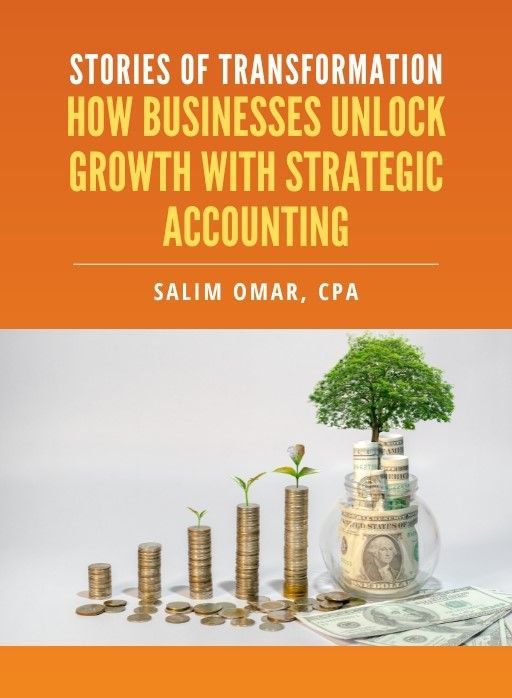
Stories of Transformation

Salim is a straight-talking CPA with 30+ years of entrepreneurial and accounting experience. His professional background includes experience as a former Chief Financial Officer and, for the last twenty-five years, as a serial 7-Figure entrepreneur.
Recent Posts