Why Growth Doesn't Always Improve Profitability

Revenue is up.
The bank account isn't.
It's one of the most frustrating places a business owner can find themselves. More customers, more employees, more work than ever, and yet financially, something feels off. The business is bigger, but it doesn't feel stronger.
After nearly three decades working with growing businesses, I've watched owners double their revenue while earning less profit than they did before the growth started. I'm Salim Omar, founder of Straight Talk CPAs, and that pattern shows up more often than most people expect.
Growth is exciting. Profitable growth is intentional. The difference usually isn't how hard the owner is working. It's whether they have enough financial visibility to recognize when growth is actually creating value and when it's just creating more complexity.
Growth Often Gets More Expensive Before It Gets Better
Every stage of growth comes with new costs. More demand means more employees. More employees mean more space. Inventory climbs. Marketing budgets expand. Those costs are expected.
The ones that catch owners off guard are the hidden ones.
Communication gets harder as the team grows. Decision-making slows down. Managers spend more time coordinating people than actually improving how things run.
New software gets added to solve problems, and before long, you're paying for systems that overlap or barely get used. Small operational issues that were easy to ignore at a smaller scale suddenly become expensive.
None of those decisions is wrong on its own. But together, quietly and gradually, they can chip away at profitability while the revenue number keeps climbing.
One pattern I've noticed over the years is that owners rarely set out to sacrifice profit. It happens because growth creates momentum, and momentum makes it easy to assume every opportunity is worth chasing. Sometimes it is. Other times it just produces a larger, more expensive version of the same business.
Revenue Doesn't Tell You Whether the Business Is Actually Winning
Revenue is one of the easiest numbers to celebrate. It's also one of the easiest to misread.
Revenue tells you how busy the business is. It doesn't tell you whether the business is becoming stronger.
The questions that actually matter are different. Are margins improving? Is enough cash being generated to support future growth? Which customers or services are producing the healthiest returns? Is overhead growing faster than revenue?
Those answers don't live on the top line of an income statement. They come from understanding where profit is being created and where it's quietly disappearing. When you have that level of visibility, growth decisions stop feeling like guesses and start feeling deliberate.
When Bigger Doesn't Mean Better
One business owner I worked with grew annual revenue by nearly 35 percent over two years. From the outside, it looked like a tremendous success story. Inside the business, the owner was still anxious before every payroll cycle.
The company had brought on more staff, started accepting lower-margin work to keep up with demand, and invested heavily in equipment without fully thinking through how those decisions would affect long-term profitability. Sales kept climbing. Cash stayed tight.
When we got into the numbers, the real picture came out. The highest-revenue services weren't producing the strongest margins. A smaller group of projects was consistently generating better profits with far fewer operational headaches.
The answer wasn't finding more work. It was being smarter about the work they said yes to. Pricing got adjusted. The team became more selective about new projects. Scheduling improved to get more out of existing capacity. Revenue growth slowed a little. Profitability improved significantly.
Growing smarter turned out to be far more valuable than simply growing faster.
The Numbers I Look at First
When a business owner asks me whether their growth is actually working, revenue isn't where I start.
I'm trying to understand whether the business is genuinely getting healthier.
Gross margin tells me whether growth is becoming more expensive over time. Operating profitability shows whether overhead is quietly eating the gains that higher sales should be producing. Cash flow reveals whether the business can actually support its own expansion without creating unnecessary financial pressure. Customer profitability helps identify whether the company is attracting the right kind of business or just more of it.
I also pay attention to something harder to measure but just as important: operational complexity.
Every new hire, service line, location, or customer segment adds complexity. Complexity isn't a problem by itself, but it needs to generate enough value to justify the additional cost, management attention, and risk that comes with it. When it doesn't, growth eventually starts working against the business instead of for it.
Visibility Changes More Than Growth Alone Ever Could
A lot of businesses don't actually have a growth problem. They have a visibility problem.
I've sat with owners who spent weeks debating whether to bring on another salesperson while having almost no clarity on whether their existing customers were actually profitable. Without reliable financial information, every major decision becomes a bet.
Forecasting changes that are entirely. Instead of reacting to what happened last month, you start planning for what the business will need six months from now. Financial reports stop being historical records and start being tools you actually make decisions with.
Looking backward explains where you've been. Looking forward helps determine where you're going. The businesses that consistently improve profitability learn to do both.
A Better Question to Start Asking
Instead of asking "how do I grow my business?" try asking "how do I make growth more profitable?"
That one shift changes how you think about pricing, hiring, expansion, which customers to pursue, where to invest operationally, and what the long-term strategy actually looks like.
At Straight Talk CPAs, those are the conversations we find most valuable with business owners. By connecting accounting, tax strategy, and financial insight, we help owners understand what their numbers are really saying, so every decision gets made with more confidence and less guesswork.
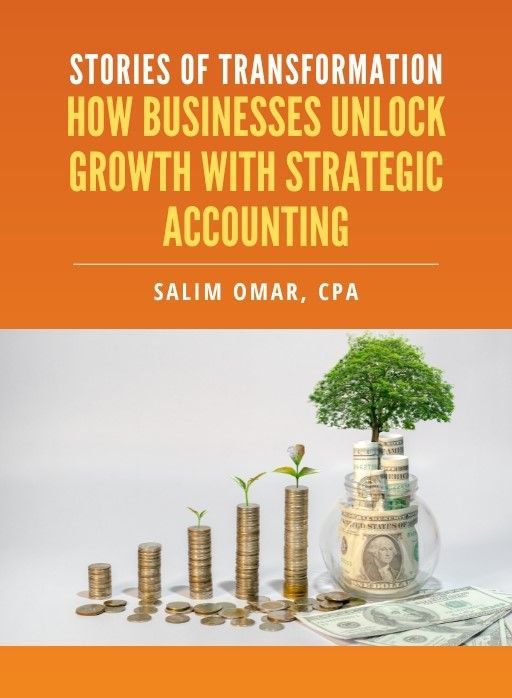
Free eBook:
Stories of Transformation

Salim is a straight-talking CPA with 30+ years of entrepreneurial and accounting experience. His professional background includes experience as a former Chief Financial Officer and, for the last twenty-five years, as a serial 7-Figure entrepreneur.
Recent Posts