Preparing Your eCommerce Business for a Smarter Tax Strategy Next Year
In our work with e-commerce businesses, we’ve noticed a consistent pattern: tax planning is often treated as something that happens toward the end of the year.
By the time most businesses start thinking about taxes, the decisions that matter most have already been made. That’s where the problem begins.
On the surface, this doesn’t seem like a problem. Financial reports are up to date. Revenue is growing. Operations are running as expected.
But the issue isn’t whether tax planning happens.
It’s when it happens and what decisions have already been locked in by that point. Tax planning at year-end doesn’t fix decisions, it reflects them.
As Salim Omar, CPA and founder of Straight Talk CPAs, often points out,
“Tax strategy doesn’t start when you prepare your return. It starts when you make decisions that affect how income and expenses are structured throughout the year.”
Why Timing Matters More Than Most Realize
Many e-commerce businesses assume they can optimize taxes once the year is nearly complete.
In practice, that window is much smaller than it appears.
Decisions related to:
- inventory purchasing
- pricing and promotions
- compensation and distributions
- platform and payment structures
All begin shaping tax outcomes long before year-end.
By the time those decisions show up in financial reports, they’re often difficult, if not impossible, to unwind without added cost or complexity.
As Omar explains,
“Most businesses don’t miss tax opportunities because they didn’t plan. They miss them because the planning started after the decisions were already made.”
When Growth Outpaces Tax Awareness
This becomes more noticeable as e-commerce businesses scale.
Higher sales volumes and faster operational cycles create more frequent decision points. Inventory moves more quickly. Marketing spend increases. Product lines expand.
From the outside, the business appears to be progressing.
Internally, the connection between those decisions and their tax impact is not always clear.
We often see businesses reinvesting aggressively into inventory, advertising, or expansion without fully understanding how those decisions affect taxable income in the current year versus future periods.
Omar notes,
“Growth creates momentum, but it also reduces the margin for error. When decisions are made quickly, tax implications are often considered later when fewer options are available.”
The Disconnect Between Reporting and Strategy
One of the biggest challenges we see is the gap between financial reporting and decision-making.
Reports are designed to show what has already happened. They explain the past. They don’t guide the decision in front of you.
Tax strategy requires understanding what current decisions will mean in the future.
When those two are not aligned, businesses tend to operate reactively:
- reviewing tax exposure after the fact
- adjusting only when necessary
- missing opportunities that required earlier action
The numbers themselves are not the issue.
It’s how they’re being used.
A Real Example: Planning That Came Too Late
We worked with an e-commerce brand in the consumer products space that had experienced steady year-over-year growth.
Revenue was strong. Cash flow was stable. The business had reinvested heavily into inventory and marketing to maintain momentum.
From the founder’s perspective, everything was on track.
But as the year progressed and tax projections were introduced, a different picture began to emerge.
“We thought we were being proactive by focusing on growth,” the founder told us. “But we weren’t thinking about how those decisions were shaping our tax position.”
By the time we engaged, several key decisions had already been made:
- Large inventory purchases were locked in
- Compensation structures had been set
- Capital had been deployed without considering the impact
There was still room to improve the outcome, but not to fully optimize it. The issue wasn’t growth; it was that decisions had been made without considering their tax impact in real time.
Our focus shifted from reacting to the current year to preparing for the next.
We worked with the client to align financial reporting with forward-looking decisions, mapping out how inventory cycles, expense timing, and structural choices would influence tax exposure before those decisions were made.
The result wasn’t just a more efficient tax outcome.
It was a shift in how the business approached planning.
As Omar puts it,
“The goal isn’t to fix taxes at the end of the year. It’s to make decisions throughout the year that lead to better outcomes by the time you get there.”
The Real Opportunity: Timing Over Tactics
What separates businesses that manage taxes effectively from those that feel constant pressure isn’t complexity.
It’s timing.
When tax strategy is treated as an ongoing consideration rather than a year-end activity, businesses gain more flexibility.
They can:
- Evaluate decisions before committing to them
- Understand trade-offs more clearly
- Adjust direction while options are still available
Without that visibility, even well-run businesses can find themselves reacting to outcomes they didn’t fully anticipate.
A Different Way to Approach the Next Year
Preparing for a smarter tax strategy doesn’t start with new tools or more detailed reports.
It starts with a different mindset.
From what we’ve seen, the businesses that navigate this well are not necessarily doing more.
They’re thinking earlier.
They’re asking:
- How will this decision impact our tax position?
- What does this mean across different periods?
- Are we structuring this in a way that supports where we’re going?
Good tax outcomes aren’t created at year-end. They’re built decision by decision.
As a final point, Omar adds,
“You don’t build a tax strategy at the end of the year. You build it through the decisions you make long before that.”
The difference isn’t in effort.
It's when clarity is applied.
Get Clarity Before You Decide
If tax planning still feels like something you deal with later, it may already be shaping your results.
We help you understand what your decisions mean before they become difficult to change.
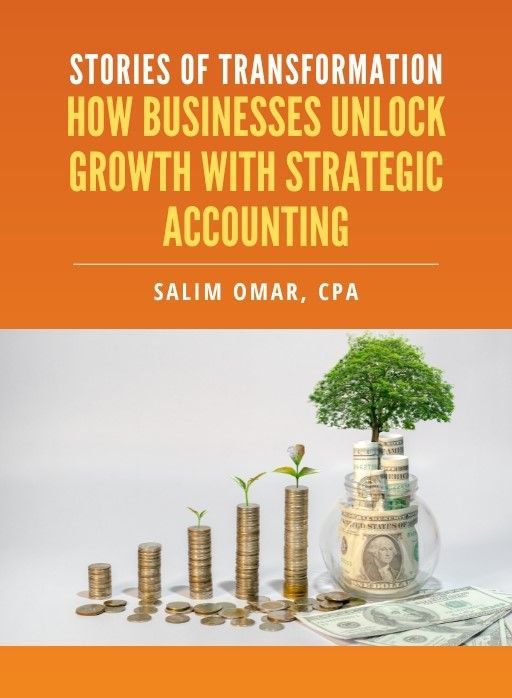
Free eBook:
Stories of Transformation

Salim is a straight-talking CPA with 30+ years of entrepreneurial and accounting experience. His professional background includes experience as a former Chief Financial Officer and, for the last twenty-five years, as a serial 7-Figure entrepreneur.
Recent Posts