
Passive vs Active Income: Why Real Estate Tax Classification Matters

In our work with real estate investors, we often see a point of confusion that doesn’t get enough attention early on.
Income is being generated. Properties are performing. Cash flow appears stable.
But how that income is classified as passive or active tends to be treated as a technical detail rather than a strategic decision.
On the surface, it may not seem urgent.
Over time, that classification starts to shape how income is taxed, how losses are used, and how future decisions play out.
Classification doesn’t just affect reporting it determines what your results actually allow you to do.
As Salim Omar, CPA and founder of Straight Talk CPAs, often points out,
“Most real estate investors focus on the deal itself. But how that income is classified determines what you’re actually able to do with the results of that deal.”
Why Classification Isn’t Just a Tax Detail
Passive and active income are not just labels.
They determine how income and losses interact across your overall financial picture.
In real estate, rental income is generally treated as passive. That means losses from those activities are often limited in how they can be applied, especially when income from other sources is involved.
At the same time, many investors assume that if a property is performing well, the classification doesn’t matter.
From what we’ve seen, that assumption is where the gap begins.
As Omar explains,
“The classification doesn’t change how the property performs. It changes how the results of that performance are treated.”
When Strong Performance Still Feels Inefficient
This becomes more noticeable as portfolios grow.
Investors may:
- Generate consistent rental income
- Incur expenses across multiple properties
- Reinvest into new acquisitions
On paper, activity is increasing.
But when tax time arrives, the way income and losses are treated doesn’t always align with expectations.
Losses may not offset other income in the way investors assumed. Deductions may be limited. Certain strategies may not apply based on how activities are classified.
The issue isn’t the performance of the properties.
It’s how that performance is structured from a tax perspective.
The Role of Participation and Structure
One of the key factors that influences classification is participation.
The level of involvement in real estate activities can affect whether income is treated as passive or active under certain conditions.
But this isn’t always straightforward.
We often see investors:
- Managing multiple properties
- Making operational decisions
- Spending significant time on their portfolio
Yet still not fully understanding how those activities translate into tax classification.
Omar notes,
“It’s not just about how much you’re involved. It’s about how that involvement is defined and documented and how it aligns with the overall structure of your investments.”
A Real Example: Activity Without Alignment
We worked with a real estate investor who had built a portfolio of rental properties over several years. The business was performing well, with consistent occupancy, stable income, and steady expansion.
From an operational standpoint, everything looked strong.
But when we reviewed the tax position, there was a disconnect.
“We were putting in the work and growing the portfolio,” the client told us. “But the tax side never seemed to reflect that.”
Despite active involvement in managing properties, the income was still being treated in a way that limited how losses could be applied. Certain deductions weren’t being utilized as effectively as they could have been.
The issue wasn’t a lack of effort.
It was that the structure didn’t reflect how the investor was actually operating.
We worked with the client to reassess how their real estate activities were organized, looking at participation levels, documentation, and overall entity structure. More importantly, we helped them understand how future decisions would influence classification outcomes before those decisions were made.
The result wasn’t just a change in reporting.
It was a clearer framework for making decisions going forward.
As Omar puts it,
“When classification is aligned with how the business actually operates, it opens up options that weren’t visible before.”
The Real Risk: Misunderstood Flexibility
What we see most often isn’t incorrect reporting.
It's a misunderstood flexibility.
When income is assumed to behave one way but is treated another, investors can:
- overestimate the benefit of certain deductions
- underestimate limitations on losses
- make decisions without fully understanding their impact
Over time, this creates a gap between expectation and outcome.
And that gap tends to show up when options are more limited.
A Different Way to Look at It
In real estate, income is often viewed through the lens of performance: cash flow, appreciation, and returns.
But from what we’ve seen, classification plays an equally important role.
It determines how those results can be used, not just how they are generated.
Performance shows what you’ve built. Classification determines what you can do with it.
As a final point, Omar adds,
“It’s not just about what your real estate investments produce. It’s about how those results fit into your overall financial picture and what that allows you to do next.”
The investors who navigate this well aren’t necessarily doing more deals.
They’re making decisions with a clearer understanding of how those deals will be treated over time.
Get Clarity Before You Decide
If your real estate income is performing well but not working the way you expected from a tax perspective, it may be time to look deeper.
We help you understand how your structure and classification shape your outcomes before it limits your options.
Free eBook:
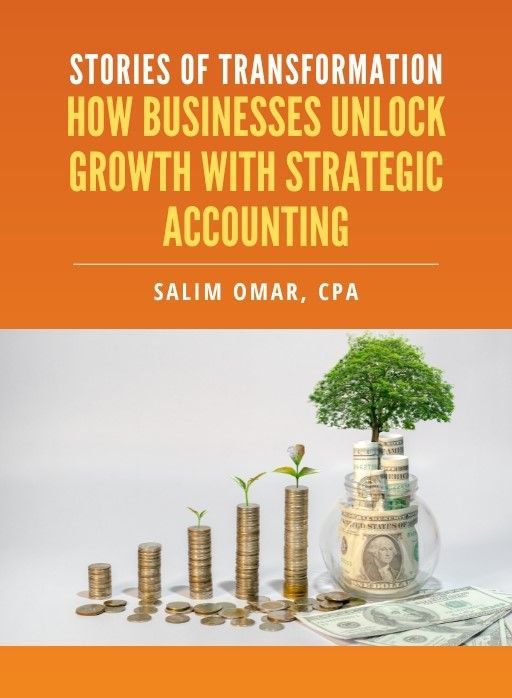
Stories of Transformation

Salim is a straight-talking CPA with 30+ years of entrepreneurial and accounting experience. His professional background includes experience as a former Chief Financial Officer and, for the last twenty-five years, as a serial 7-Figure entrepreneur.
Recent Posts