Understanding Business Deductions: What Your CPA Looks For

Most business owners approach deductions the same way every year:
What can I write off?
That question is already too late—and it’s the reason many businesses pay more tax than they should, even while “claiming everything.”
At Straight Talk CPAs, deductions aren’t evaluated as a list of expenses. They’re evaluated as evidence of how a business operates. Systems. Decisions. Timing. Discipline. When those are strong, deductions follow naturally. When they aren’t, even legitimate deductions become risky, limited, or unusable.
This article explains what a CPA is actually evaluating when reviewing business deductions—and why the difference between “having expenses” and “claiming deductions properly” is where most tax outcomes are won or lost.
Deductions Are Not a Strategy—They’re an Outcome
From a CPA’s perspective, deductions are not something you “go after.”
They are the result of:
- How expenses are tracked
- When decisions are made
- Whether records are clean and consistent
- How intentional the business is throughout the year
When companies try to optimize deductions without fixing these fundamentals, CPAs are forced into defensive positions—conservative treatment, reduced flexibility, and higher effective tax bills.
Strong deduction outcomes don’t come from aggressiveness.
They come from
structure.
The First Question a CPA Asks (Even If They Don’t Say It)
Before looking at how much was deducted, a CPA is asking:
Does this expense make sense for how this business actually operates?
That means evaluating whether the expense:
- Is ordinary and necessary for
this type of business
- Clearly tied to revenue, operations, or growth
- Would hold up if reviewed by an outside party
- Aligns with industry norms and business behavior''
An expense doesn’t become deductible just because money left the bank account. Context matters. Intent matters. Pattern matters.
At STCPA, deductions are reviewed through the lens of
business reality, not theoretical tax allowances.
Documentation Isn’t a Form Requirement—It’s a Risk Control
Missing expenses don’t cause most deduction problems.
They’re caused by missing systems.
CPAs look for:
- Clean transaction records
- Logical, consistent categorization
- Supporting context for non-obvious expenses
- Documentation that matches how the expense was actually used
Weak documentation forces CPAs to limit deductions—not because they want to, but because unclear records increase audit exposure and professional liability.
When documentation is handled throughout the year, deductions expand safely. When it’s patched together at filing time, options disappear.
Consistency Is One of the Strongest Signals CPAs Trust
Inconsistent books quietly destroy deduction quality.
CPAs immediately look for:
- Similar expenses are treated the same way
- Stable categories month over month
- Clear, repeatable allocation methods
- Year-over-year continuity unless a real change occurred
Inconsistency doesn’t always indicate wrongdoing—but it always increases scrutiny. Consistency builds credibility, speeds filing, and unlocks planning flexibility.
This is why “mostly clean” books are not clean enough.
Timing Determines Whether Deductions Are Strategic or Missed
Two businesses can incur the same expense and end up with very different tax outcomes.
Why? Timing.
CPAs evaluate:
- Cash vs accrual treatment
- Expense vs capitalization decisions
- Acceleration or deferral opportunities
- How deductions interact with revenue timing and entity structure
Many deduction opportunities are lost simply because decisions were made after the window closed. Once the year ends, strategy becomes cleanup.
STCPA works upstream—before decisions are locked in—because that’s where leverage exists.
Mixed-Use Expenses Are Where Most Businesses Get Hurt
Vehicles, home offices, travel, meals, technology—these are common deductions and common audit triggers.
CPAs don’t just ask whether these expenses exist. They evaluate:
- Clear separation between business and personal use
- Reasonable, documented allocation methods
- Supporting records (mileage, usage, purpose)
- Consistency across the year
Overreaching here doesn’t increase savings. It increases exposure. Proper structure creates deductions that stand without stress or second-guessing.
Industry Context Changes What’s Reasonable
A deduction that’s normal in one business can be questionable in another.
CPAs evaluate deductions relative to:
- Industry standards
- Business size and maturity
- Revenue model
- Growth stage
Generic tax advice ignores this context. Strategic tax planning depends on understanding how the business actually runs, not just what the tax code allows in isolation.
This is a key reason STCPA avoids template-driven
tax prep.
Deductions Must Make Sense Beyond the Tax Return
Maximizing deductions isn’t always the smartest move.
CPAs also consider:
- Cash flow impact
- Profitability optics
- Lender or investor expectations
- Long-term tax positioning
Sometimes, preserving clean financials and predictable cash behavior matters more than pushing deductions aggressively. The goal isn’t just to reduce tax—it’s to maintain
decision-ready numbers that support growth.
Red Flags CPAs Notice Immediately
Certain patterns raise concern fast:
- Large year-end expense dumps
- Rounded numbers with no explanation
- Inconsistent owner expense treatment
- Reconstructed or backfilled records
- Sudden category spikes without a business explanation
These don’t always eliminate deductions—but they reduce confidence and increase review time. Fixing them late is expensive. Preventing them early is not.
Why CPA Involvement Timing Determines Deduction Quality
Most deduction issues don’t come from bad intent.
They come from
late CPA involvement.
When a CPA is involved only at filing time:
- Planning options disappear
- Risk tolerance drops
- Strategy becomes conservative
- Opportunities are missed
When a CPA is involved throughout the year:
- Deductions are planned, not discovered
- Timing decisions are intentional
- Records naturally support positions taken
This is the operating model STCPA is built on—because reactive tax prep always costs more in the long run.
The Bottom Line
Business deductions aren’t about finding more expenses.
They’re about building a structure where deductions are
accurate, defensible, and optimized by design.
When books are clean, decisions are timely, and context is clear:
- Deductions improve
- Risk decreases
- Tax outcomes become predictable
Straight Talk CPAs
don't just help clients claim deductions. They help businesses operate in a way where deductions work
for them year after year. That level of control doesn’t come from checklists or last-minute filings—it comes from clarity, structure, and CPA involvement before pressure sets in.
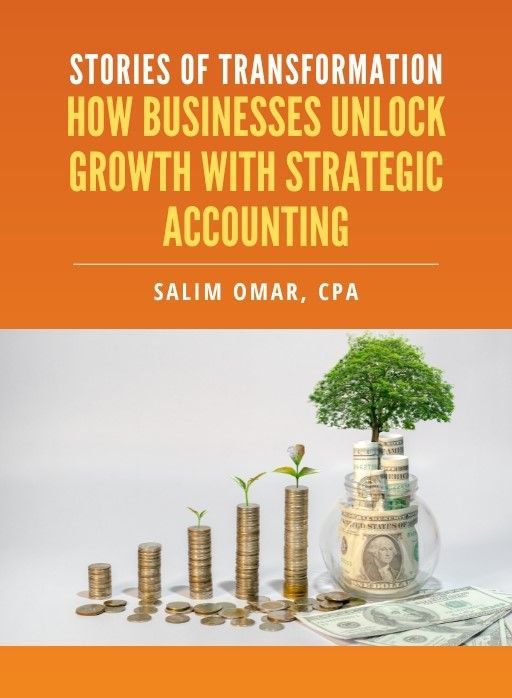
Free eBook:
Stories of Transformation

Salim is a straight-talking CPA with 30+ years of entrepreneurial and accounting experience. His professional background includes experience as a former Chief Financial Officer and, for the last twenty-five years, as a serial 7-Figure entrepreneur.
Recent Posts