
Why Fast-Growing Businesses Struggle Most at Tax Time

Growth tends to solve visible problems.
Revenue increases. Hiring becomes easier. Expansion feels justified.
From the outside, the business looks stronger with each step forward.
But tax time often tells a different story.
Growth makes the business bigger. It also makes the gaps more visible.
Not because something went wrong, but because growth changed the structure of the business faster than the financial strategy could keep up.
As Salim Omar, CPA and founder of Straight Talk CPAs, often explains,
“Growth doesn’t create tax problems. It exposes the ones that were already there.”
Growth Changes the Game: Quietly
In the early stages, financial decisions tend to be simpler, with fewer transactions, fewer moving parts, and lower stakes. As the business grows, that simplicity begins to disappear.
What once felt like straightforward decisions, pricing, hiring, and reinvestment start to carry layered implications, affecting how income is recognized, how expenses are timed, and how profits flow through the business.
The shift isn’t always obvious, but it begins to influence outcomes long before tax season arrives.
When Momentum Replaces Visibility
One of the patterns we see in fast-growing businesses is momentum taking the lead.
Decisions are made quickly:
- New hires are added
- Marketing spend increases
- Expansion opportunities are pursued
Each decision makes sense on its own.
But collectively, they begin to outpace the visibility needed to understand their full impact.
By the time financial reports catch up, the structure is already in place.
As Omar notes,
“Growth speeds up decisions. But it doesn’t always speed up clarity. That gap is where tax pressure starts to build.”
Why Tax Season Feels Disproportionately Heavy
When tax season arrives, businesses expect it to reflect their performance.
Instead, it often reflects their structure.
Revenue may be strong, but:
- Deductions may not align with income timing
- Prior decisions may limit flexibility
- Certain opportunities may no longer be available
This creates a disconnect.
The business feels like it’s doing well.
But the tax outcome suggests otherwise.
A Real Example: Growth Without Alignment
We worked with a service-based business that had nearly doubled its revenue within a year.
From an operational standpoint, things were moving in the right direction. The team had expanded, new services had been introduced, and client demand was increasing.
But when tax projections were prepared, the outcome was unexpected.
“We thought growth would make things easier,” the founder told us. “Instead, it feels like we’re being penalized for it.”
When we reviewed the situation, there wasn’t a single issue driving the result.
It was a combination of decisions made throughout the year:
- Revenue had increased faster than expenses could offset
- Compensation and distribution structures hadn’t been adjusted
- Certain timing decisions had already locked in the tax position
Nothing was technically wrong.
But the structure hadn’t kept pace with the growth.
We worked with the client to realign their financial approach—adjusting how income flowed, how decisions were evaluated, and how future planning was integrated earlier in the process.
The result wasn’t just a better tax outcome.
It was a shift in how growth decisions were made going forward.
As Omar puts it,
“The issue isn’t growth itself. It’s growing without adjusting how decisions are structured as the business evolves.”
The Real Issue: Structure, Not Effort
What stands out in these situations isn’t a lack of effort or ambition; it’s structure. Tax strategy is often introduced only after the effects of growth are already visible, when many of the key decisions have already been made.
At that point, options are more limited.
From what we’ve seen, the businesses that navigate growth more effectively aren’t necessarily doing more planning; they’re doing it earlier.
A Different Way to Think About Growth
Growth is often measured by revenue.
But from a financial perspective, it’s better understood as increasing complexity.
More revenue means:
- more decisions
- more interactions between those decisions
- less room for error
As Omar explains,
“The faster a business grows, the more important it becomes to understand how each decision connects. Otherwise, the outcomes start to drift away from expectations.”
Growth doesn’t just scale results; it scales the consequences of how decisions are made.
Before the Next Phase of Growth: Revisit the Structure
If your business is growing quickly, tax season shouldn’t be the first time you evaluate the impact of your decisions.
It should be a checkpoint not a surprise.
We help you align your financial structure with your growth so that your next set of decisions works with your tax position, not against it.
Free eBook:
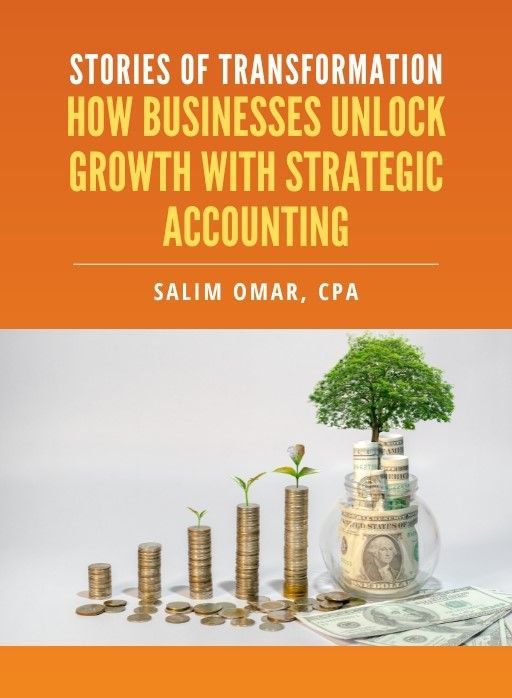
Stories of Transformation

Salim is a straight-talking CPA with 30+ years of entrepreneurial and accounting experience. His professional background includes experience as a former Chief Financial Officer and, for the last twenty-five years, as a serial 7-Figure entrepreneur.
Recent Posts