
Hiring, Expansion, or Cost Control? Let Your Numbers Decide

At Straight Talk CPAs, we see the same pattern every year.
Growth decisions don’t fail because leaders lack vision.
They fail because decisions are made before the numbers are ready.
Hiring, expansion, and cost control are not strategic choices in isolation. There are financial consequences. Each one draws from the same limited pool of cash, margin, and operational capacity. When those inputs are unclear, decisions feel urgent—but unstable.
The real risk isn’t choosing the wrong move.
It’s choosing without understanding what the business can actually sustain.
That’s why the smartest growth decisions aren’t driven by instinct, pressure, or momentum.
They’re driven by
decision-ready numbers.
Why These Decisions Feel Harder Than They Should
Most businesses don’t struggle because they lack data.
They struggle because their financial data isn’t usable.
Revenue reports exist. Bank balances are visible. Expenses are recorded. Yet when leadership sits down to decide whether to hire, expand, or tighten costs, uncertainty creeps in.
Common warning signs include:
- Revenue is growing, but cash feels tight
- Margins look acceptable, but profits don’t accumulate
- Hiring feels necessary, but risky
- Expansion sounds exciting, but stressful
- Cost control feels reactive rather than strategic
This uncertainty doesn’t come from ambition.
It comes from
numbers that describe the past but can’t support the future.
When financials aren’t structured for decision-making, every option feels equally risky. That’s when businesses stall—or worse, pursue multiple directions at once without committing to any of them fully.
What “Letting the Numbers Decide” Really Means
Letting the numbers decide does not mean deferring leadership to spreadsheets.
It means
using accurate financial data to define the boundaries of smart action.
Decision-ready numbers answer questions like:
- What level of growth is sustainable without outside pressure?
- How much risk is already embedded in current operations?
- Which decision strengthens the business six to twelve months out?
- Where does flexibility exist—and where it doesn’t?
When numbers are accurate, current, and structured properly, they do more than report performance. They frame choices.
Instead of debating opinions, leaders evaluate trade-offs.
Instead of guessing, they prioritize.
That’s the difference between reactive growth and intentional scaling.
Hiring: Growth Accelerator or Cash Drain?
Hiring is often the first response to growth pressure. Workloads increase. Bottlenecks appear. Service quality is strained. Adding people feels like progress.
But hiring without financial clarity turns a short-term solution into a long-term liability.
Decision-ready numbers allow leaders to evaluate:
- Whether the current cash flow can support the role for 12–18 months
- How the hire impacts margins, not just capacity
- Whether inefficiency is driving the need, or actual demand
- How long does it take for the role to become cash-neutral
Without this visibility, hiring is funded by optimism.
With it, hiring becomes a calculated investment.
The numbers don’t just say can you afford this hire today.
They reveal whether the business can carry the cost if growth slows, clients churn, or expenses rise.
That clarity transforms hiring from a reaction into a strategy.
Expansion: Strategic Growth or Controlled Chaos?
Expansion is where strong businesses differentiate—or destabilize themselves.
New locations, services, markets, or capacity all introduce complexity. Expansion increases revenue potential, but it also amplifies inefficiencies, cash strain, and margin pressure.
Clean, accurate financials reveal:
- Whether current margins can absorb expansion costs
- How expansion shifts cash timing and working capital needs
- The revenue threshold required to break even
- Which cost structures scale—and which don’t
Expansion driven by unclear numbers feels exhilarating at first.
Then it becomes operationally expensive and financially exhausting.
Expansion driven by clarity feels measured. Controlled. Repeatable.
The numbers don’t decide
whether to expand.
They define
how far, how fast, and at what risk level.
Cost Control: Strategic Protection or Growth Sabotage?
Cost control is often misunderstood. It’s treated as a defensive move—something businesses do when things go wrong.
In reality, cost control is a precision tool.
Decision-ready books separate:
- Structural costs from temporary spikes
- Necessary investment to avoid avoidable waste
- Margin pressure from deliberate growth spending
This distinction matters.
Without clarity, businesses cut indiscriminately. Morale drops. Capacity shrinks. Growth stalls.
With clarity, businesses protect what matters while trimming what doesn’t.
Cost control becomes proactive rather than reactive.
It preserves flexibility instead of limiting it.
The goal isn’t spending less.
It’s spending
intentionally.
Why Businesses Get Stuck Doing All Three
When numbers are unclear, businesses often fall into a dangerous middle ground.
They:
- Hire cautiously, but not confidently
- Expand partially, without full commitment
- Cut costs reactively, without a strategy
The result is diluted focus and mixed signals across the organization.
Teams don’t know whether they’re in growth mode or protection mode.
Leadership feels busy but not decisive.
Momentum slows quietly.
The problem isn’t ambition.
It’s the absence of financial clarity to support a single, intentional direction.
What Financial Clarity Actually Delivers
When bookkeeping and reporting are accurate, current, and structured properly, the impact goes far beyond compliance.
Strong financial clarity delivers:
- Faster decision cycles
- Clear trade-offs between options
- Predictable cash behavior
- Stable margins during growth
- Confidence under pressure
Most importantly, it removes emotional guesswork from strategic decisions.
Hiring becomes a math problem.
Expansion becomes a model, not a gamble.
Cost control becomes targeted, not reactive.
That’s when leadership shifts from managing uncertainty to directing outcomes.
This Is Why Bookkeeping Is Growth Infrastructure
Many businesses treat bookkeeping as a historical task—something done to close the month or satisfy compliance.
That mindset caps growth.
When bookkeeping is structured intentionally, it becomes infrastructure:
- It supports forecasting and scenario planning
- It feeds advisory insight
- It reduces risk as complexity increases
- It enables confident decision-making
Scaling businesses don’t outgrow bookkeeping.
They outgrow
unstructured bookkeeping.
The difference shows up first in decisions—long before it shows up in results.
Bottom Line
At Straight Talk CPAs, we don’t believe growth decisions should feel stressful, rushed, or uncertain.
Hiring, expansion, and cost control aren’t competing strategies.
They’re
outcomes of
financial clarity.
When the numbers are reliable, the next move becomes obvious.
When they aren’t, even good options feel risky.
Let the numbers decide—before pressure, urgency, or momentum decides for you.
Because the most expensive growth mistake isn’t choosing the wrong path.
It’s committing to a path without knowing where it leads.
And that’s exactly where accurate, structured financials make the difference—turning uncertainty into control, and ambition into deliberate, repeatable growth.
Free eBook:
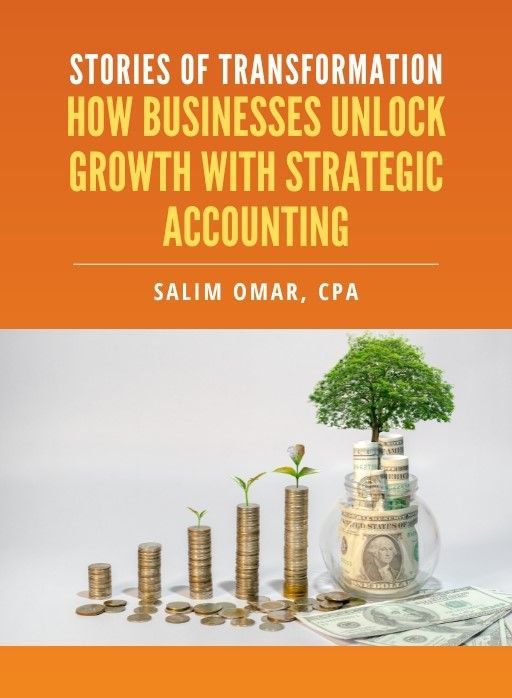
Stories of Transformation

Salim is a straight-talking CPA with 30+ years of entrepreneurial and accounting experience. His professional background includes experience as a former Chief Financial Officer and, for the last twenty-five years, as a serial 7-Figure entrepreneur.
Recent Posts