How a Year-End CFO Review Can Save You Thousands in Taxes

A profitable year means nothing if your tax bill wipes out the win. And that’s exactly what happens when businesses push year-end financial reviews to the background.
A smart CFO review doesn’t just “clean up” your numbers — it restructures your tax position, eliminates silent leaks, and turns late-year decisions into real cash savings.
At Straight Talk CPAs, we see it every year: owners leave money on the table simply because no one connected the dots between financial performance and tax strategy. A year-end CFO review fixes that — and fast.
Let’s break down where the real savings hide.
1. Expose Tax Liabilities Before They Become Tax Problems
Most business owners only see their tax bill when it’s too late to change it. A CFO review reveals that mistake.
Evaluate:
- Income spikes that trigger higher brackets
- Poorly timed revenue recognition
- Missed deductions are sitting in your general ledger
- Expenses that should be reclassified before year-end
Insight: The IRS doesn’t reward hindsight. Timing is your biggest tax lever — and it only works if you analyze early.
Example: A professional services firm shifted invoicing on two December projects and legally reduced taxable income by $43,000. Same work. Smarter timing.
2. Optimize Deductions You’re Likely Undercounting
Most deductions aren’t missed because people forget — they’re missed because no one ran the numbers strategically.
A CFO review identifies:
- Underclaimed depreciation
- Section 179 or bonus depreciation gaps
- Missed home-office, vehicle, or reimbursement opportunities
- Employer benefits that can be expanded before year-end
When you align deductions with actual financial behavior, the savings add up — and compound annually.
Pro tip: Revisit anything labeled “miscellaneous.” That’s where thousands hide.
3. Fix Entity-Structure Mismatches That Inflate Taxes
Your entity may have made sense when you started — but not after you grew.
A CFO review examines:
- Whether your income level justifies an S-Corp
- Whether you’re overpaying self-employment tax
- Whether multi-owner structures are optimized
- Where liability and tax strategy conflict
Insight: Entity structure is one of the highest-impact tax tools — and one of the least reviewed.
Example: A contractor switching from sole prop to S-Corp cut self-employment taxes by $18,700 — purely from structural alignment.
4. Rebalance Owner Compensation Before December 31
Owner pay is one of the most overlooked tax levers. If it’s too low or too high, you’re either overpaying taxes or triggering compliance risks.
CFO review looks at:
- Reasonable compensation benchmarks
- Distribution strategy
- Payroll timing
- Tax-efficient bonus planning
Dialing this in before year-end ensures IRS alignment — and keeps more money in your pocket.
5. Identify Tax-Efficient Investments Before the Window Closes
Tax savings don’t come from April paperwork — they come from December decisions.
A CFO review helps you evaluate:
- Retirement contributions
- Charitable strategies
- Equipment purchases
- R&D or energy-efficiency credits
- Timing of planned capital investments
Insight: Saving thousands isn’t about adding complexity — it’s about sequencing the right moves at the right time.
Common Misconceptions
- “I’ll let my accountant handle taxes later.”
Later is too late. Strategy disappears once the calendar flips.
- “I made money — I’ll just pay what I owe.”
You might be overpaying by thousands if no one adjusted your position before year-end.
- “I don’t need CFO oversight — I’m not a big company.”
Tax inefficiency hits small businesses harder because every dollar matters.
Why a CPA-Led CFO Review Changes the Game
A CFO review isn’t bookkeeping. It’s strategic financial leadership.
With the right year-end analysis, you can:
- Reduce tax liability while staying fully compliant
- Strengthen cash flow heading into Q1
- Reorganize compensation and distributions
- Align entity, income, and tax strategy
- Build a smarter foundation for next year’s profitability
At Straight Talk CPAs, we turn your financials into a tax strategy that actually protects the bottom line.
Bottom Line
Your year-end CFO review is the single most important step you can take to safeguard your profits — and lock in tax savings before the window closes.
If you want the new year to start with momentum instead of regret, review your numbers now and act strategically while you still can.
When you’re ready, we’ll help you extract hidden savings and build a tax plan that’s
purposeful, optimized, and built for growth.
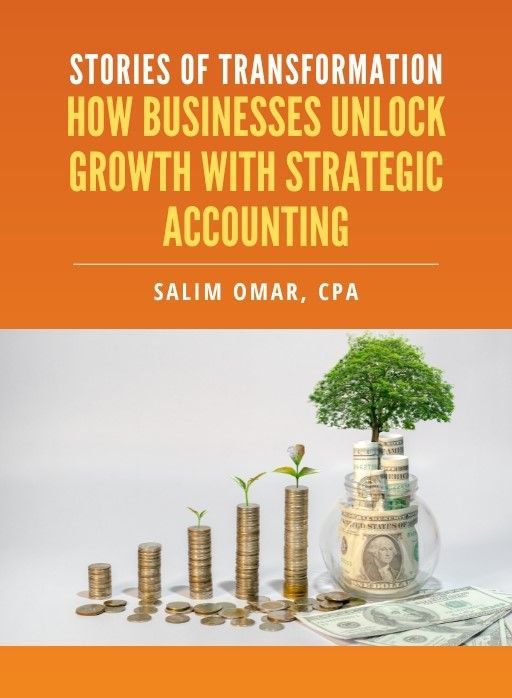
Free eBook:
Stories of Transformation

Salim is a straight-talking CPA with 30+ years of entrepreneurial and accounting experience. His professional background includes experience as a former Chief Financial Officer and, for the last twenty-five years, as a serial 7-Figure entrepreneur.
Recent Posts