
How Missed Deductions Compound Over Time for Property Owners

For many property owners, deductions are something that gets reviewed once a year.
They show up during tax preparation, get applied where possible, and then move on.
On paper, that process seems sufficient.
But what often goes unnoticed is not the deductions that are claimed, it’s the ones that are consistently missed, deferred, or misunderstood over time.
And more importantly, what those missed opportunities begin to compound into.
Missed deductions don’t just reduce savings, they reshape long-term returns.
As Salim Omar, CPA and founder of Straight Talk CPAs, often explains,
“Missed deductions don’t just affect one tax year. They influence how efficiently your entire portfolio performs over time.”
It Doesn’t Start as a Big Problem
In most cases, nothing appears obviously wrong. A deduction may be overlooked, a classification slightly off, or an opportunity deferred because it doesn’t seem urgent at the time.
Individually, these gaps don’t feel material. They don’t disrupt operations or trigger immediate concern, and the overall performance of the portfolio still appears intact.
But in
real estate, where decisions build on each other, small inefficiencies rarely stay isolated. Over time, they carry forward and begin to reshape outcomes in ways that aren’t immediately visible.
Where the Gaps Typically Show Up
From what we’ve seen, missed deductions are rarely about a lack of effort.
They usually come from how financial decisions are structured and tracked.
Common patterns include:
- expenses that are recorded but not fully categorized for tax treatment
- capital improvements that aren’t optimized for depreciation strategies
- passive losses that are not fully utilized or carried forward strategically
- timing decisions that push deductions into less impactful periods
None of these is unusual.
But when they happen repeatedly, they start to affect more than just tax savings.
They affect how efficiently capital is being used.
The Compounding Effect Most Investors Don’t See
Real estate is often viewed as a long-term game, which makes small inefficiencies easy to ignore. Missed deductions don’t create immediate disruption, and as a result, they’re rarely treated as urgent.
But they also don’t reset each year.
Instead, they accumulate quietly in the background, influencing how efficiently capital is preserved and redeployed over time. What seems like a minor gap in one period can begin to affect multiple areas of the business as it carries forward.
Over time, this can lead to:
- higher effective tax rates than necessary
- Reduced cash available for reinvestment
- slower portfolio growth compared to what was possible
As Omar notes,
“It’s not just about what you missed this year. It’s about what that missed opportunity prevents you from doing in the years that follow.”
That second layer is where the real impact sits.
A Real Example: When “Close Enough” Adds Up
We worked with a property owner who had built a portfolio of rental properties over nearly a decade.
The business was stable. Occupancy was strong. Cash flow was consistent.
From a reporting standpoint, everything looked in order.
But the investor had a lingering concern:
“I feel like we’re doing fine, but not as well as we should be.”
When we reviewed the financials, we found no major issues.
Instead, there were multiple smaller gaps:
- Certain expenses were not being fully optimized for tax treatment
- Depreciation strategies had not been revisited as the portfolio evolved
- Prior-year opportunities had not been carried forward strategically
None of these stood out individually.
Collectively, they had created a pattern of missed efficiency.
The issue wasn’t a lack of deductions; it was a lack of structure around how they were being used.
We worked with the client to realign how deductions were identified, timed, and applied—looking not just at the current year, but how those decisions connected across multiple years.
The impact wasn’t immediate in a dramatic way.
But over the following periods, the difference became clearer:
- improved tax positioning
- more consistent cash availability
- better alignment between performance and outcomes
As Omar puts it,
“Most investors don’t notice this because nothing breaks. But over time, ‘close enough’ becomes expensive.”
Why This Often Goes Unnoticed
One of the reasons this issue persists is that it rarely creates urgency. There’s no obvious failure point; returns are filed, properties perform, and cash flow remains intact.
From the outside, everything appears acceptable.
But without a clear view of what could have been optimized, there’s no real baseline for comparison. What looks stable on the surface may still be leaving room for improvement from a structural standpoint.
A Different Way to Think About Deductions
Deductions are often viewed as something to capture.
In practice, they function more like a strategy.
They influence:
- How capital is preserved
- How quickly can portfolios scale
- How efficiently income is managed across periods
As Omar explains,
“Deductions are not just about reducing taxes. They’re about improving how your portfolio performs after taxes over time.”
That shift in perspective changes how decisions are made.
What This Means Going Forward
For property owners, the question isn’t just whether deductions are being claimed.
It’s whether they’re being:
- identified correctly
- timed effectively
- aligned with long-term strategy
Because in real estate, small gaps don’t stay small.
They compound.
And over time, they define the difference between stable growth and optimized growth.
Before You Make Your Next Move: Look at What’s Been Missed
If your portfolio is performing well but not translating into the results you expected, it may not be about what you’re doing next.
It may be about what’s been quietly left unoptimized.
We help you identify those gaps and structure your decisions so they don’t keep repeating.
Free eBook:
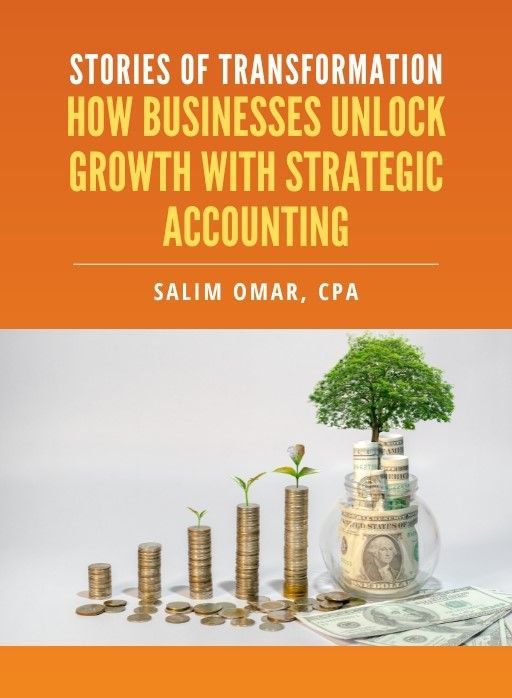
Stories of Transformation

Salim is a straight-talking CPA with 30+ years of entrepreneurial and accounting experience. His professional background includes experience as a former Chief Financial Officer and, for the last twenty-five years, as a serial 7-Figure entrepreneur.
Recent Posts