Cash Flow Forecasting for the Year Ahead: A CPA’s Playbook

Cash flow doesn’t fail suddenly.
It weakens quietly—decision by decision—until flexibility disappears.
Most business owners don’t lose control because revenue drops. They lose it because cash timing stops matching expectations. Payments arrive later. Expenses stack earlier. Taxes hit harder than planned. And suddenly, growth feels constrained—even when the business looks healthy on paper.
This is why cash flow forecasting matters more at the start of the year than at any other point.
Not as a spreadsheet exercise.
As a control system.
Why Last Year’s Numbers Aren’t Enough
Looking backward explains performance.
Looking forward protects decisions.
Many businesses enter the year relying on:
- Prior-year cash balances
- Average monthly expenses
- Assumptions that “things will smooth out.”
That works—until it doesn’t.
Growth introduces new variables:
- Hiring timing
- Expansion costs
- Tax payments
- Debt obligations
- Changes in customer payment behavior
Without forecasting, these variables collide instead of coordinating.
Cash flow forecasting doesn’t predict the future.
It
reveals pressure points before they become problems.
What Cash Flow Forecasting Actually Controls
Cash flow forecasting isn’t about knowing your balance next December.
It’s about controlling decisions between now and then.
A proper forecast answers:
- When cash is tight—not just if
- Which decisions increase pressure
- How much flexibility actually exists
- What must happen for growth to remain funded
At Straight Talk CPAs, forecasting is treated as a decision filter, not a financial report. The goal is straightforward: to ensure that no major move is made without considering its economic impact.
The CPA Difference: Forecasting vs Guessing
Many forecasts fail because they’re built on averages.
CPAs don’t forecast averages.
They forecast
behavior.
That includes:
- Real collection timing, not invoice dates
- Fixed vs variable cost behavior under growth
- Tax payment schedules, not estimates
- Owner compensation decisions and distributions
This is where CPA-led forecasting separates from DIY models.
A CPA’s role is to stress-test assumptions before the business does.
The Core Components of a CPA-Led Cash Flow Forecast
1. Operating Cash Reality
The starting point is not revenue—it’s cash conversion.
CPA-led forecasting examines:
- How fast revenue turns into cash
- Where delays consistently occur
- Which clients or services create drag
This removes the illusion that “sales solve cash problems.”
They don’t. Timing does.
2. Cost Expansion Under Growth
Growth changes cost behavior.
Forecasting identifies:
- Which costs scale with volume
- Which costs step up suddenly
- Which costs must remain controlled
This prevents the common mistake of growing revenue faster than cash capacity.
3. Tax Cash Impact (Not Just Tax Expense)
Taxes affect cash long before returns are filed.
A CPA forecast integrates:
- Estimated payments
- Timing of liabilities
- Impact of profit fluctuations
This prevents Q2 and Q3 cash shocks that stall momentum.
4. Decision Scenarios, Not Static Projections
The most valuable forecasts are dynamic.
CPA-led forecasting models scenarios:
- What happens if hiring is delayed?
- What if collections slow by 15 days?
- What if expansion starts earlier?
Instead of guessing, owners see consequences before committing.
That’s control.
How Forecasting Changes the Way Owners Decide
Once cash flow is forecasted properly, decision-making changes immediately.
- Hiring Becomes Confident
Owners know when payroll becomes sustainable—not just affordable.
- Expansion Becomes Timed
Growth happens when cash supports it, not when pressure forces it.
- Stress Drops
Surprises decrease because outcomes are anticipated, not reacted to.
- Leverage Increases
Cash becomes a strategic asset—not a constraint.
This is why forecasting isn’t optional for scaling businesses. It’s fundamental.
Why January Is the Right Time to Build the Forecast
January provides the cleanest planning window:
- Prior-year data is visible
- Commitments haven’t compounded
- Corrections are least disruptive
Waiting until mid-year turns forecasting into triage. January turns it into a strategy.
At Straight Talk CPAs, cash flow forecasting is built early so decisions throughout the year are guided—not guessed.
Cash Flow Forecasting as Risk Management
Most business risk isn’t market-driven.
Its liquidity driven.
Forecasting reduces risk by:
- Making constraints visible
- Exposing fragile assumptions
- Preventing forced decisions
Businesses rarely fail because they lack opportunity.
They fail because cash timing removes their choices.
Forecasting protects choice.
Bottom Line
Revenue measures activity.
Profit measures efficiency.
Cash flow determines survival and control.
CPA-led cash flow forecasting ensures:
- Growth is funded, not forced
- Decisions are timed, not rushed
- Taxes are anticipated, not feared
- Flexibility is preserved as complexity increases
If growth is on the agenda this year, forecasting isn’t optional.
It’s the playbook.
Because the strongest businesses aren’t the ones with the most revenue.
They’re the ones who never lose control of cash.
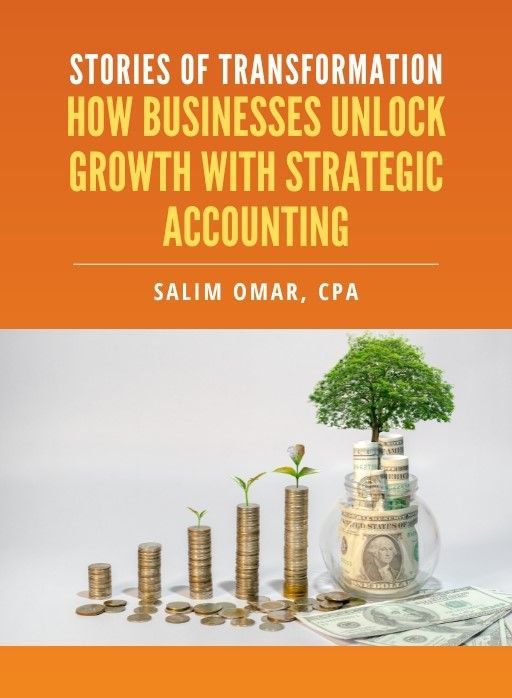
Free eBook:
Stories of Transformation

Salim is a straight-talking CPA with 30+ years of entrepreneurial and accounting experience. His professional background includes experience as a former Chief Financial Officer and, for the last twenty-five years, as a serial 7-Figure entrepreneur.
Recent Posts