
How CPA-Led Financial Goal Setting Creates Measurable Growth

January is when most business owners say they want growth.
Very few define what that actually means in financial terms.
“Grow revenue.”
“Improve profitability.”
“Scale operations.”
Those aren’t goals. Their intentions.
Real growth only happens when financial goals are defined with precision, tied to real constraints, and guided by someone who understands how every decision flows through cash, taxes, and risk. That’s where CPA-led financial goal setting changes the equation.
Not as an annual exercise.
As an operating discipline.
Why Most Financial Goals Fail by March
Most January goals fail for one reason: they’re disconnected from financial reality.
Business owners often set targets based on:
- Last year’s revenue plus optimism
- Market pressure or competitor benchmarks
- Personal ambition without financial modeling
What’s missing is structure.
Without understanding margins, cash flow timing, tax exposure, and operational capacity, goals become guesses. And guesses don’t scale.
By Q2, the symptoms show up:
- Cash gets tight despite higher revenue
- Hiring decisions feel rushed or reversed
- Taxes feel unpredictable instead of planned
- Growth creates stress instead of leverage
Growth without financial alignment doesn’t compound. It fractures.
What CPA-Led Goal Setting Does Differently
CPA-led financial goal setting starts with a different premise:
Growth is only meaningful if it’s measurable, fundable, and sustainable.
Instead of asking “How much do you want to grow?”, the right process asks:
- What level of profit must growth produce?
- How much cash must remain available to support it?
- What tax impact will growth create?
- What risks increase as revenue increases?
At Straight Talk CPAs, financial goal setting is not a motivational exercise. It’s a diagnostic one.
The objective is simple: align ambition with financial infrastructure before execution begins.
Turning Goals Into Financial Control Points
CPA-led goal setting translates vision into control points—the financial markets that determine whether growth is working or working against you.
1. Revenue Targets That Respect Reality
Revenue goals are evaluated against:
- Historical growth patterns
- Client mix and margin contribution
- Capacity constraints (people, systems, delivery)
Instead of chasing top-line numbers, the focus shifts to quality revenue—the kind that improves cash flow and reduces volatility.
Growth that strains operations is not growth. It’s deferred cleanup.
2. Profit as a Primary Metric, Not an Afterthought
CPA-guided planning anchors goals in:
- Target operating margins
- Required reinvestment levels
- Owner compensation strategy
This ensures profit isn’t something you “see later.”
It’s something you plan for upfront.
When profit is intentional, decisions get sharper—pricing, hiring, and expansion stop being emotional and start being mathematical.
3. Cash Flow as the Growth Governor
Cash is the constraint most owners underestimate.
CPA-led goal setting stress-tests:
- Timing gaps between revenue and collections
- Fixed cost expansion vs variable flexibility
- Upcoming tax and debt obligations
The result is growth paced by liquidity—not optimism.
You don’t just ask, “Can we grow?”
You ask, “Can we fund this growth without breaking cash discipline?”
4. Tax Impact Integrated From Day One
Most financial goals ignore taxes until it’s too late.
CPA-led planning integrates:
- Projected tax liabilities
- Entity structure efficiency
- Timing strategies that preserve cash
This prevents the common mistake of growing into a tax surprise that erodes gains.
Smart growth isn’t just about earning more.
It’s about keeping more—predictably.
Why CPA Guidance Changes Decision Quality
When financial goals are CPA-led, decision quality improves across the board.
Owners stop asking:
- “Can we afford this?”
And start asking:
- “Does this align with our financial model?”
That shift changes everything.
Hiring becomes deliberate.
Expansion becomes timed.
Risk becomes visible.
Growth becomes controlled.
Instead of reacting to numbers after the fact, owners use numbers as a forward-looking tool.
That’s the difference between managing a business and engineering one.
Measurable Growth Is a System, Not a Moment
The real value of CPA-led goal setting isn’t the January plan.
It’s what happens throughout the year.
Clear goals create:
- Monthly benchmarks instead of vague progress
- Early warning signs instead of late surprises
- Adjustments made proactively—not under pressure
Growth becomes measurable not because it’s tracked—but because it’s structured.
When bookkeeping, forecasting, and advisory insight work together, financial goals stop being static targets. They become a decision framework.
Bottom Line
Growth doesn’t fail because owners lack ambition.
It fails because ambition isn’t anchored in financial reality.
CPA-led financial goal setting ensures that:
- Growth improves profitability, not just revenue
- Cash remains a tool, not a stress point
- Taxes are planned, not reacted to
- Decisions compound instead of conflicting
January is not about setting hopeful goals.
It’s about setting
defensible, measurable, and executable ones.
When financial goals are built with CPA guidance, growth stops being aspirational—and starts becoming inevitable.
Free eBook:
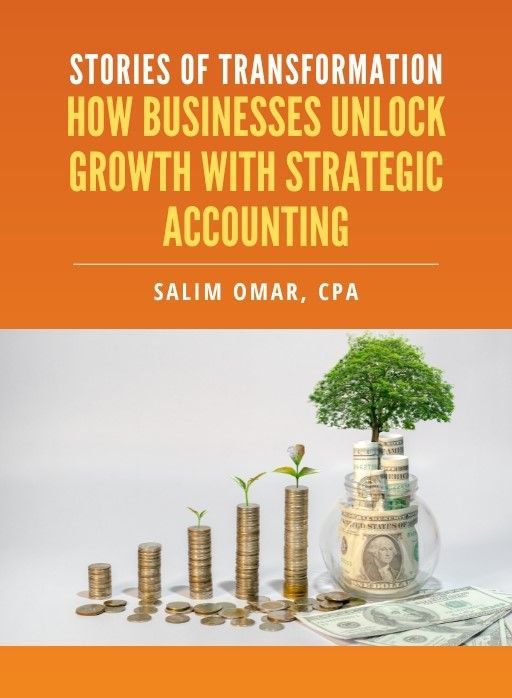
Stories of Transformation

Salim is a straight-talking CPA with 30+ years of entrepreneurial and accounting experience. His professional background includes experience as a former Chief Financial Officer and, for the last twenty-five years, as a serial 7-Figure entrepreneur.
Recent Posts