The Business Owner’s Tax Prep Checklist (CPA-Approved)
A Straight Talk CPA's Signature Guide to Filing Without Friction
At Straight Talk CPAs, we don’t look at tax prep as a seasonal task.
We look at it as a leadership competency.
Every year, the same pattern repeats. Some business owners move through tax season calmly, decisively, and on schedule. Others experience delays, surprise tax bills, and rushed decisions they don’t fully trust.
The difference isn’t intelligence.
It isn’t an effort.
And it isn’t even revenue size.
Its preparation quality.
This guide exists to make that difference unmistakable.
Reframing Tax Prep: What Serious Business Owners Understand
Tax prep does not begin when documents are requested.
It begins when your financial picture becomes
clear enough to act on.
When preparation is weak:
- CPAs are forced to interpret instead of advice
- Tax strategy becomes conservative by necessity
- Filing timelines stretch
- Errors surface later
When preparation is strong:
- Decisions are faster
- Strategy expands
- Risk contracts
- Filing becomes procedural
This guide is not about doing more work.
It’s about eliminating friction
before it shows up.
The Straight Talk Tax Prep Standard
Forget scattered checklists and last-minute scrambles.
From a CPA’s perspective, tax prep readiness comes down to
four non-negotiable conditions.
If these are met, tax season works.
If they aren’t, everything downstream slows.
Condition 1: Your Numbers Are Final — Not “Close Enough”
Tax prep cannot begin until your financials are finished, not approximate.
This means:
- All bank and credit card accounts reconciled
- All transactions are categorized accurately
- No suspense, clearing, or “we’ll fix it later” accounts
- The year formally closed
When books are still moving, tax prep stalls.
When books are final, everything accelerates.
Clean books don’t just save time—they expand what your CPA can safely do on your behalf.
Condition 2: Your Financial Story Makes Sense
CPAs don’t just file numbers.
They defend them.
Your financials must tell a coherent story:
- What was normal vs. what was unusual
- What was the investment vs. what was waste?
- What changed—and why
One-time expenses, asset purchases, legal costs, financing events—these must be clearly identified. Without that clarity, tax positions become conservative by default.
Conservative positions cost money.
Condition 3: Owner Activity Is Clearly Defined
This is where many otherwise strong businesses create avoidable risk.
Your CPA needs precise visibility into:
- Owner compensation
- Draws or distributions
- Personal expenses (if any)
- Reimbursements
Blurring business and personal activity does more than slow filing—it limits tax flexibility and raises scrutiny.
Clear separation protects both sides of the equation: tax efficiency and credibility.
Condition 4: Payroll and Compliance Are Locked In
Payroll errors are among the most expensive and time-consuming tax issues to unwind.
Before tax prep begins, payroll must be:
- Finalized
- Reconciled
- Aligned with reported wages and benefits
This includes bonuses, reimbursements, and any mid-year changes. If payroll is still being questioned, tax prep pauses. Period.
What Happens When These Conditions Are Met
When these four conditions are satisfied, tax preparation shifts dramatically.
Instead of asking:
“What’s missing?”
Your CPA can ask:
“What’s optimal?”
This is where strategy becomes possible:
- Timing decisions
- Entity-level considerations
- Deduction optimization
- Risk management
None of that happens if the preparation is incomplete.
Why Filing Delays Are Almost Always Self-Created
Filing delays are rarely caused by CPAs or the IRS.
They’re caused by unresolved inputs:
- Incomplete books
- Unclear classifications
- Missing context
- Late disclosures
When information arrives in pieces, tax prep becomes iterative. Iteration consumes time.
Preparation compresses timelines.
Reaction expands them.
The Hidden Cost of “We’ll Handle It Later”
Many business owners assume tax prep urgency is a March or April problem.
That assumption is expensive.
Late preparation:
- Shrinks planning options
- Forces conservative positions
- Increases the likelihood of extensions
- Pushes decisions under pressure
Pressure is not where good tax outcomes are made.
Tax Prep Is a Reflection of Business Discipline
Here’s the uncomfortable truth:
Smooth tax seasons are not luck.
They’re signals.
They signal:
- Operational discipline
- Financial clarity
- Leadership control
Chaotic tax seasons signal the opposite—even when revenue is strong.
This isn’t about perfection.
It’s about readiness.
The Straight Talk Perspective
At Straight Talk CPAs, we don’t measure tax success by whether a return was filed.
We measure it by:
- How early clarity was achieved
- How few assumptions were required
- How confident the decisions felt
- How little friction existed
Tax prep should feel predictable, not stressful.
Controlled, not reactive.
Strategic, not rushed.
That outcome doesn’t happen in April.
It’s built long before.
Bottom Line
The best tax outcomes aren’t created by clever last-minute tactics.
They’re created when:
- Numbers are final
- Context is clear
- Owner activity is structured
- Payroll is locked
When those conditions exist, tax prep becomes exactly what it should be: a confirmation of control—not a scramble for it.
That’s the standard at
Straight Talk CPAs.
And that’s the difference business owners feel when preparation is done right.
Free eBook:
Stories of Transformation
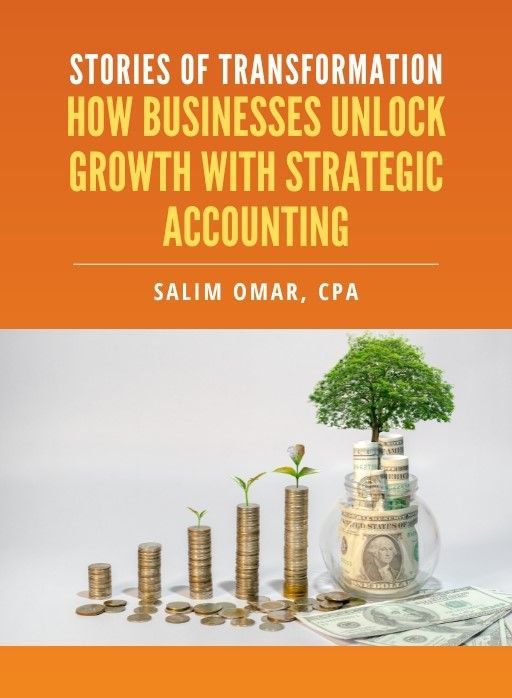

Salim is a straight-talking CPA with 30+ years of entrepreneurial and accounting experience. His professional background includes experience as a former Chief Financial Officer and, for the last twenty-five years, as a serial 7-Figure entrepreneur.
Recent Posts